The Solow Model (or Solow Growth Model) focuses on long-run economic growth.
- Recall from Cobb-Douglas Production Function,
is the capital intensity. usually,
- Capital Accumulation Equation
- : investment
- Investment Equation (What’s new here)
- is the investment rate, usually in the data.
Note: is the parameter.
- National Income Account (In a close economy)
so
Summary of the solow model
The Central Equation of Solow Model is:
or we could write as: (after I study ECON4004 Advanced Macroeconomics)
This is a one-dimensional dynamic system
So the growth rate of the capital would be:
It determines the behaviors of capital over time ⇒ determines behavior of all the other endogenous variables because they all depend on .
Per Capital Production Function
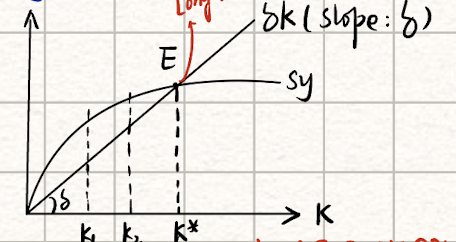
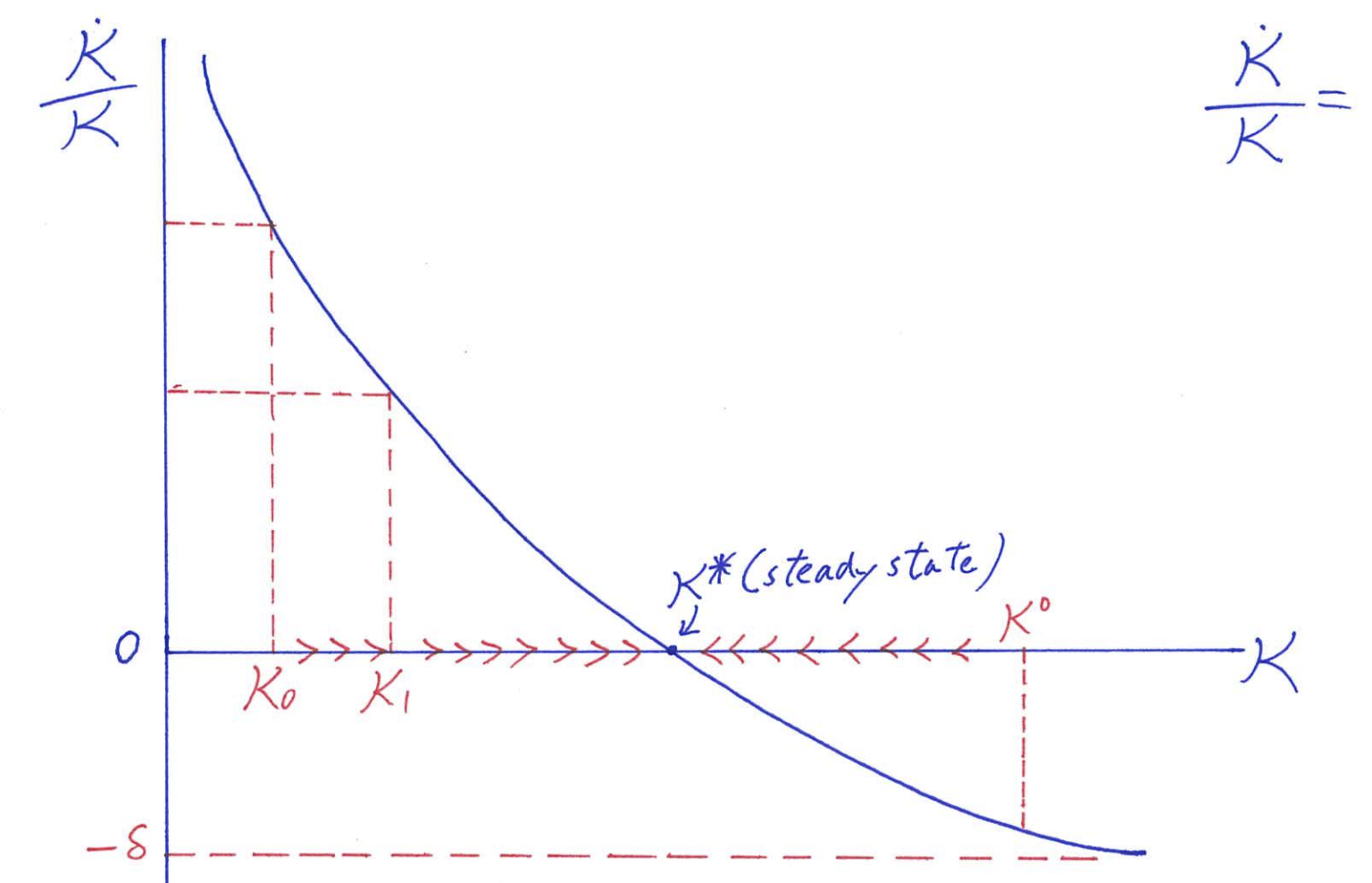
Or we could draw like this: the difference is how we treat the vertical axis.
When , which means , that means the investment is just enough to cover the depreciation. The Steady State occur.
We use to represents the Steady State situation.
Then we can move to the methodcalled Golden Rule
The technological progress is assumed exogenous (i.e. the value of is given)
That means:
Exercise
Q1: Derive the steady-state level of and . (Hint: set , so we could derive , put into the production function for .)
Answer:
Q2: What happens when increases?
The Phase Diagram:
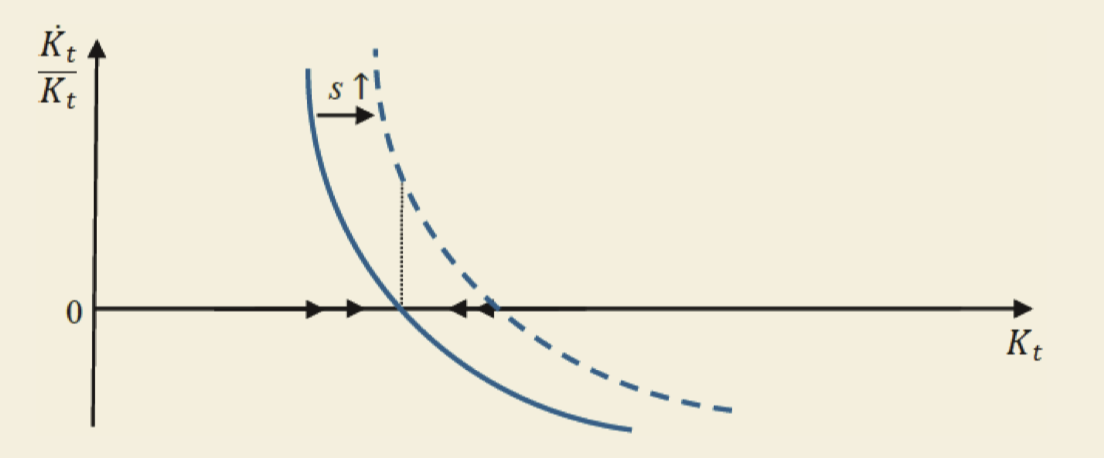
Comparative Static: .
At , we have an increase in , becomes positive in the short-run. So, rises over time and converges to . At the new steady state, remains constant in the long-run.
Effects of a higher saving rate:
:
- a higher growth of in the short-run.
- a higher level of in the long-run.
Here, we do not have economic growth in the long-run. When converges to a steady state, output also converges to a steady state.
Since the capital accumulation itself won’t generate so much increase in output in the long-run, To sustain growth in the long-run, we need technological progress (i.e. growth in ).
We assume that , here is a parameter.
The Solow Model treats as exogenous.
From
Balanced Growth Path: Each variable grows at a constant rate in the long-run. So steady-state is a special case of balanced growth path, which is 0
On the BGP, is constant (in the long-run). so of course is constant. The conclusion is that in the long-run.
The train of thought is definition → implication
We combine the equations, then we could get
- If , then in the long-run.
Empirical Implications
In the data, in the long-run among developed countries
, since , so
A technology growth rate over 2 centuries could increase income level from \1000$52k$
The Solow Model tells us that: technological progress is crucial for economic growth in the long-run.
However, the Solow Model does not tell us where technological progress comes from. It assumes to be a parameter. It only allows us to explore the proximate causes (capital and technology) of growth.
We want to go one step further to explore the fundamental causes of growth.
Two important parameters:
- determines the long-run growth rate.
- determines the long-run level of output.
The question is why do these two parameters differ across countries?