我的想法
出租公司?
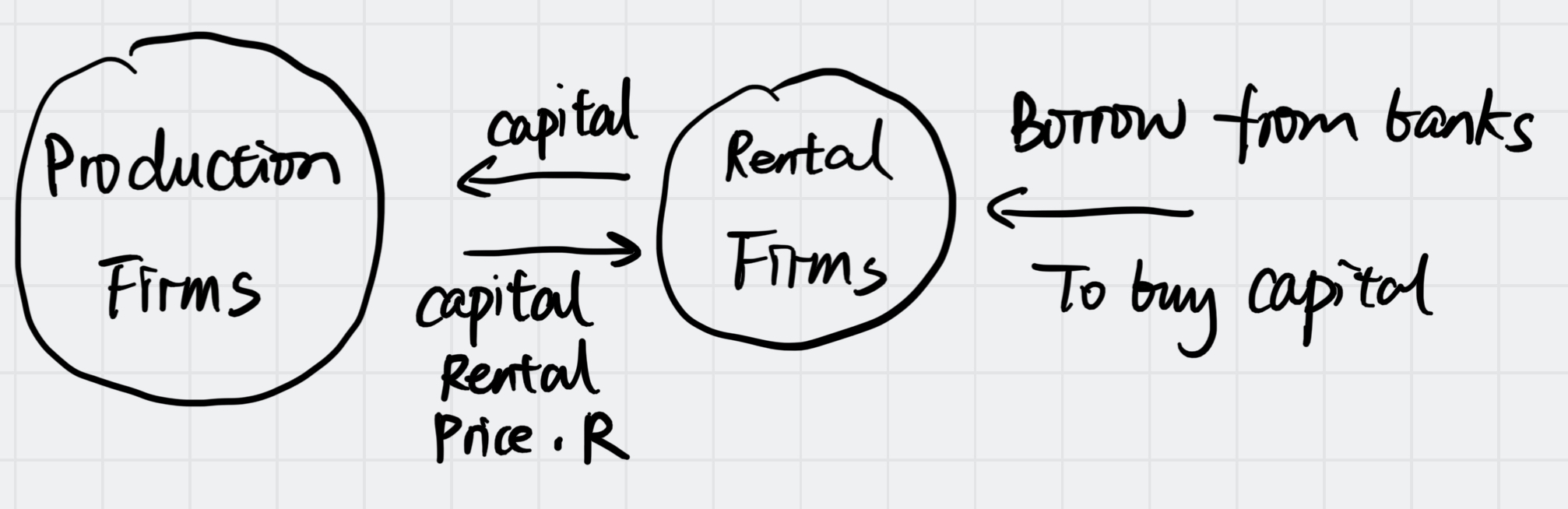
Notice that
- Rental price of 1 unit of capital, it is a constant
- The output price, it is a constant
One additional unit of capital is used to produce
= What the production firms can earn!
If , a good idea to rent more capital!
If , a good idea to rent fewer capital!
很简单,只要你的产出能够大于你的租金(成本),那就肯定要多产出呗(初级经济学的思想)
In Equilibrium,
< = >
Let us consider the behavior of rental firms
They Benefit of buying c
The Costs of owning/renting out capita
- A rental firm burrows to buy 1 unit of capital. So, it has to pay interest on loan. Let the price of 1 unit of capital be: Let i be the nominal interest rate
- When rental firm is renting out capital, the price of capital can change ( i.e. )
if the price of capital falls, the rental firm losses. i.e. A capital loss
if the price of capital increases, the rental firm gains, i.e. A capital gain.
- Let be the rate of depreciation cost, so the depreciation cost becomes:
So, 1+2+3 = Total cost of renting out 1 unit of capital =
- Ex 1 A car rental Co buys car for $10,000 each
Car price rises at 6% per year
Total\ cost=1,000-600-2,000=\2,400$
Total Cost of renting out 1 unit of capital
where is nominal interest rate, and is inflation rate
Then, real cost of renting out 1 unit of capital
Remark:
Q: How does a rental firm decide whether to buy more or less capital stock?
Define real profit per unit of capital :
Recall: is the equilibrium condition for the production firms!
if , Rental firms capital stock
if , Rental firms capital stock
When ,
Rental firms should follow this condition to decide the optional amount of to use!
⇒
When
and
then
Strongly connected to Solow Model
The left one: if increases. The right one: When MPK increases.
Macroeconomics 11 th edition, Mankiw Lecture Notes 3.22