Ramsey growth model endogenise in the Solow Model. The question is what determines the saving rate?
The key difference between Ramsey Model and Solow Model is that in Ramsey Model, household chooses to maximize .
We introduce an optimizing household to the Solow Model.
Household
Recall that
Hamiltonian
F.O.C:
We could derive that
and
The optimal consumption path in the Ramsey Model
- If , then because the household wants to invest in capital and reduce the consumption today in order to enjoy a higher level of consumption in the future.
Two differential equations
There are 2 endogenous variables
This dynamic system converges to the steady state (We won’t do it here since it is an undergrad course)
Steady state:
We have a steady state because is constant.
If , then
Steady-state level of capital:
How does the household’s discount rate affect
As the household becomes more important by discounting future utility at a higher rate, it accumulates less capital.
Culture (People’s preference) affects Economic Growth.
- Solow: The saving rate affects economic growth
- Ramsey: The household’s discount rate affects saving and Economic Growth:
But what about income? it decreases. ()
income =
Deriving the steady-state saving rate.
记得补充笔记
- In the Solow Model, is exogenous.
- In the Ramsey Model, is endogenous and chosen by the household.
Ramsey Model with a Perfect Competition Market
The setting of the Ramsey Model in the market economy is unrealistic. In a market economy, firms are the ones who produce output.
So, we will introduce a market economy and firms to the Ramsey Model. We will refer to this extended version as a decentralized Ramsey Model.
Firms
and we could derive the and by F.O.C…
Household
- Decentralized Ramsey Model:
- Centralized Ramsey Model:
It is surprised that by firms, , so that the outcome of decentralized and centralized are the same.
Note that the doesn’t always hold.
The centralized Ramsey Model is not realistic, but important. because it gives us an optimal allocation. Decentralized Ramsey Model gives us a market allocation. If market allocation is not the same as the optimal allocation, we could consider there could be a Market Failure, which is not efficient.
Decentralized Ramsey Model.
Hint: the firms do not care about the households’ fortune. They only care about their own profit.
However, by maximizing profit, the firms chooses ,which ends up maximizing the household’s utility.
The reason is that a market economy with perfect competition (and without externality) yields an efficient allocation of resources.
From the firms’ profit maximization problem,
Exercise: Derive the steady-state saving rate in the decentralized Ramsey Model.
Monopolistic
| Competitive Ramsey Model | Monopolistic Ramsey Model |
|---|---|
Monopolistic distortion reduces the rental price of capital (relative to ), such that the household accumulates a lower level of capital than the optimum.
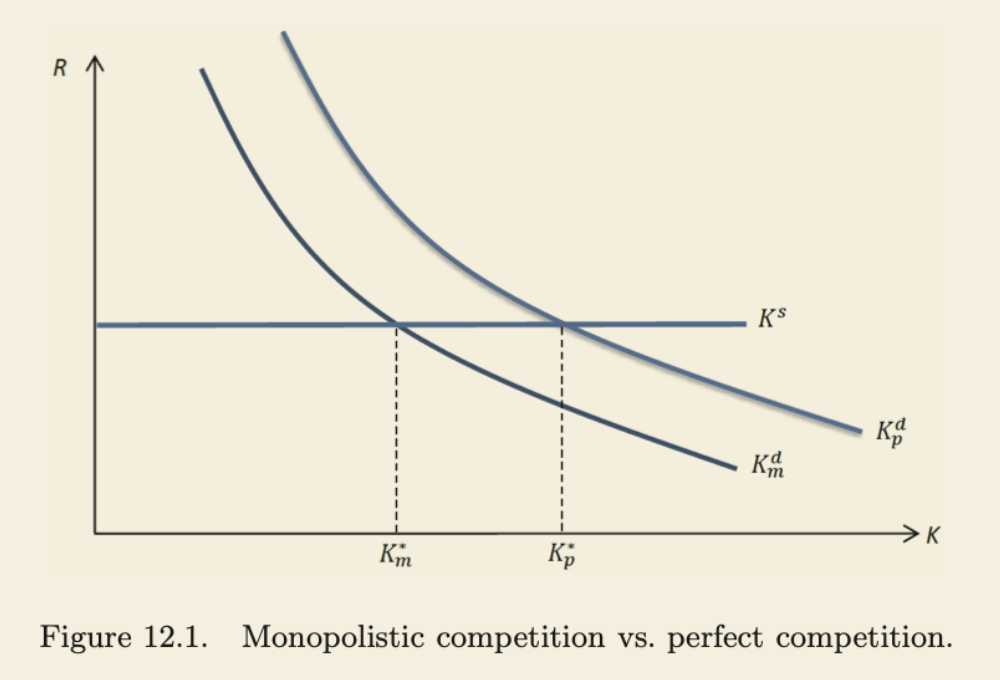
- so that
Final Good
We take the FOC:
This is the demand function for
Intermediate Goods
- Production function: .
- Profit function:
Recall that we define:
In the competitive Ramsey Model, the government, the government should not subsidize capital investment because the levels of capital and output are already at the optimal levels, without government intervention.