Finally!!! The advanced level course taught in UM.
You can find the related materials in: ECON2005 Intermediate Macroeconomics
Modern Macroeconomic model?
- Dynamic: The economic variable would change due to time, and is affected by policies.
- General Equilibrium: All economic agents in the market (households, firms, government, etc.) reach equilibrium at the same time and all markets are cleared (i.e. supply and demand are equal)
Dynamic General Equilibrium (DGE) is complicated.
Lecture 1 Macro Data
Two components:
- Economic Growth: it determines the slope of the trend of GDP.
- Business Cycle: it determines the fluctuations around the trend.
You used the Solow Model to study economic growth. You used IS-LM model (Keynesian) to study economic fluctuations.
Hamiltonian: Only need to apply, no need to prove, just like Largrangian Theory
- Hamiltonian函数的经济含义:1. 代表了经济系统在某一时点的”总价值” 2. 包含了当期收益和未来价值的变化 3. 表示状态变量的边际价值
In short, we will develop a modern macroeconomic model to study both growth and fluctuations.
It is also the purpose to study this course.
Modern Macroeconomic Model
It features dynamic general equilibrium (DGE) with microeconomic foundation.
Market Economy
Try to represent Market Economy using a simple graph.
Consumers Firm
Firms Consumers
In microeconomic foundation, consumers seek to maximize utility, and firms try to maximize profit. Consumers and firms interact in the labor market, the capital market, and the output market.
The road to study this course: Microeconomic Foundation → General Equilibrium → Dynamic, and this is the Modern Macro
We will study how the different markets affect each other.
Static General-Equilibrium Model
Firms maximize profit
Some notations:
-
Profit:
-
Price:
-
Output:
-
Labor:
-
Capital:
-
Wage:
-
Rental price of capital:
-
Technology:
-
Profit function of a firm:
-
Production function:
is the degree of capital intensity in production. In the real world data, (Western countries and China)
Recall the Profit function of a firm:
Replace by Cobb-Douglas Production Function
FOC: (The right hand side is the )
→ this is the demand function for capital.
We could find that when increases, decreases, this is the law of demand, which reflects the concept of the microeconomic foundation
→ this is the demand function for labor.
Real wage = (Left hand side = Right hand side)
The capital demand curve would be like a decreasing convex c, this is the law of demand.
The lack of IS-LM model: it didn’t reflects the microeconomic foundation.
To draw the labor market and capital market is simple, we could derive the demand curve using the equations just mentioned before, to derive the supply curve, we simply make the labor supply be perfectly inelastic. (这里补一个图)
Question: What happens to the economy when goes up?
Answer: in both graph (capital and labor), the and both shift upwards. ( and )
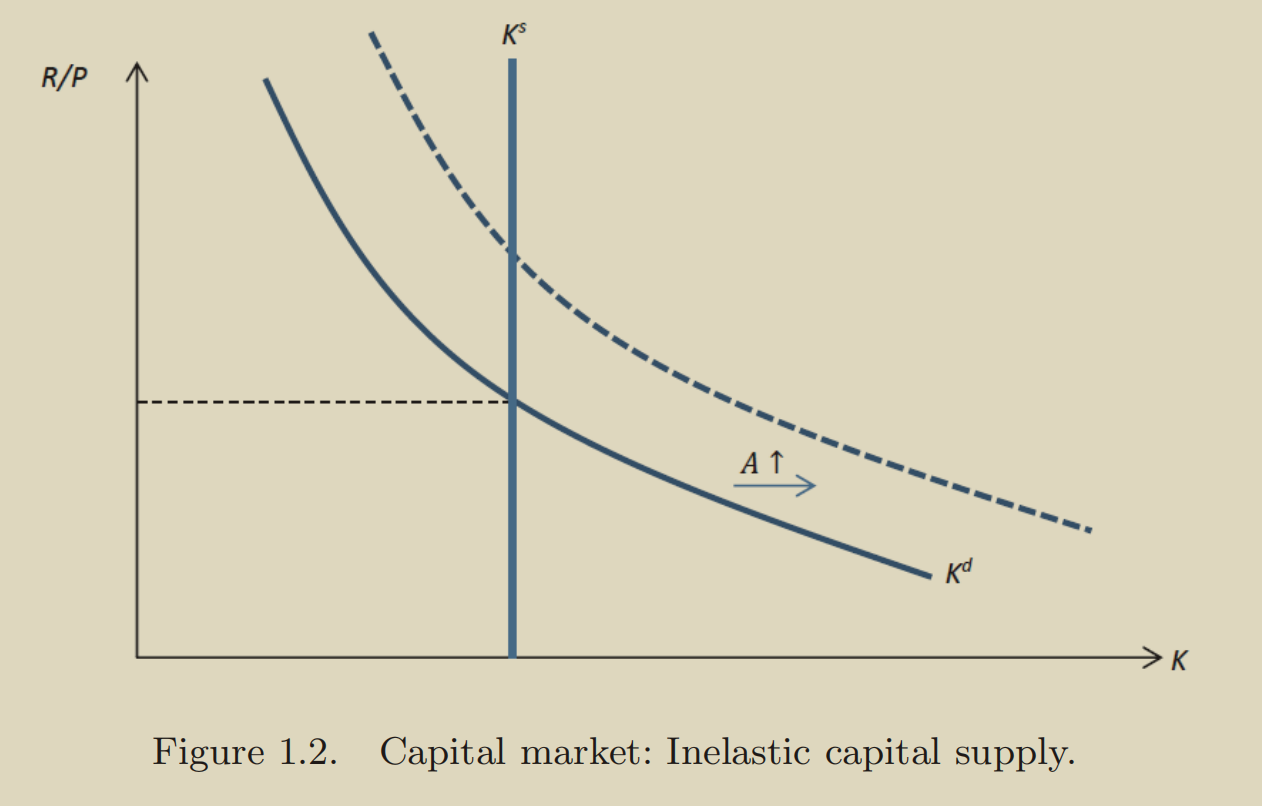
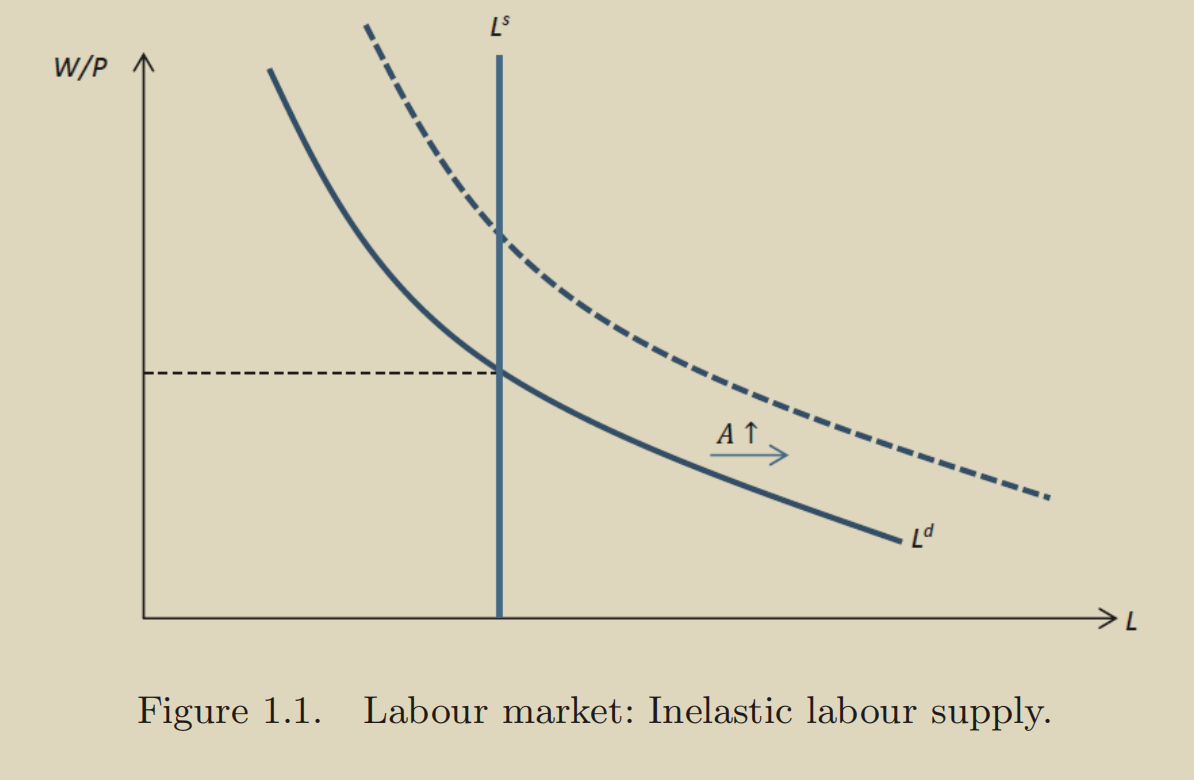
In general,
- Labor Market:
- Supply Market:
- Output Market:
Since in the perfectly inelastic case, and don’t change, only , so also.
How about the elastic case?
Consider the elastic labor supply case:
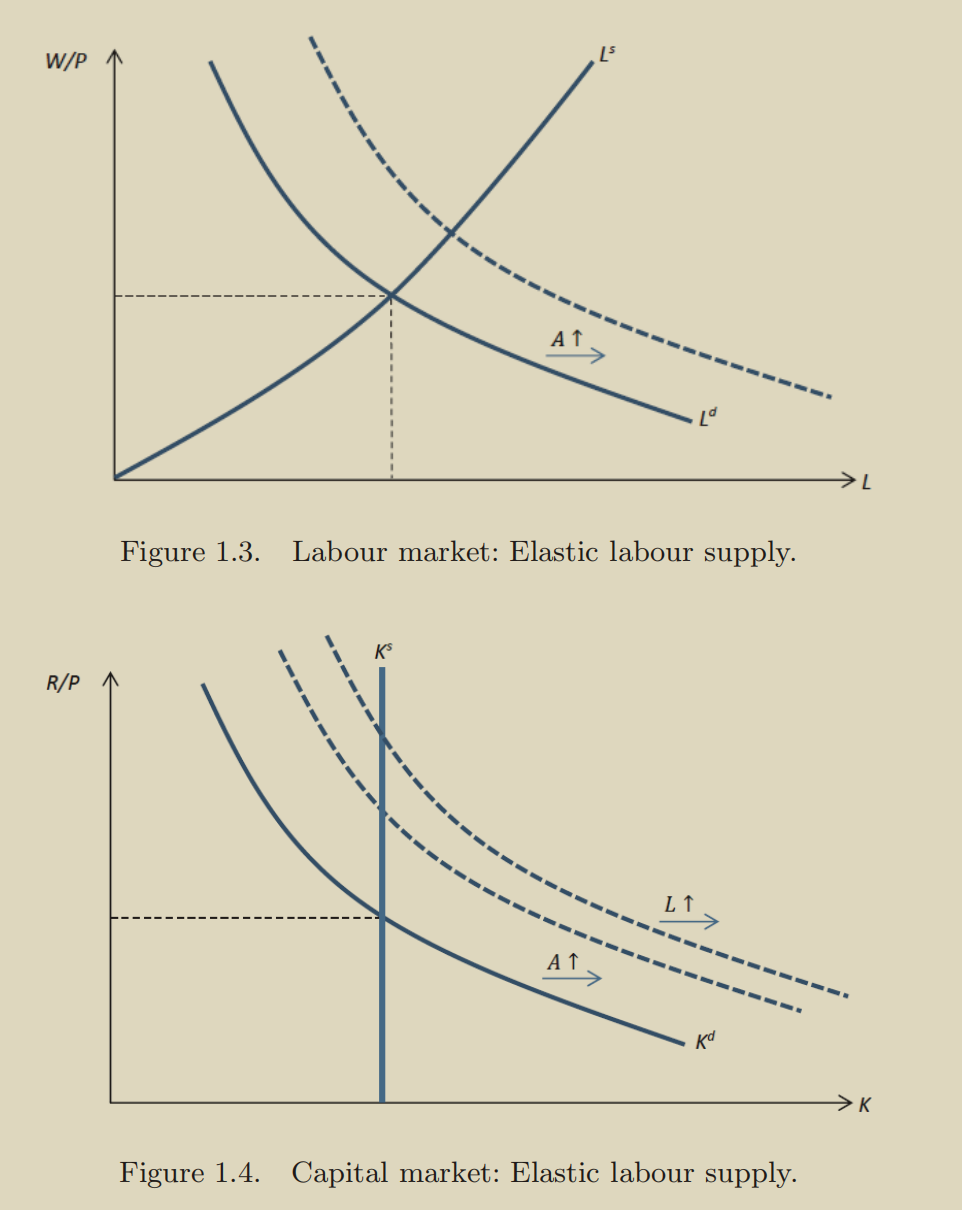
The key concept here is that, we recall the equation:
The result in the labor market is that the quantity of labor goes up, so that the change in the capital market should involves into an additional shift. (,)
In general,
- Labor Market:
- Supply Market:
- Output Market: , increases due to two reasons.
In conclusion, what happens in the labor market affects the capital market, this is a general-equilibrium effect.
What about both markets are elastic?
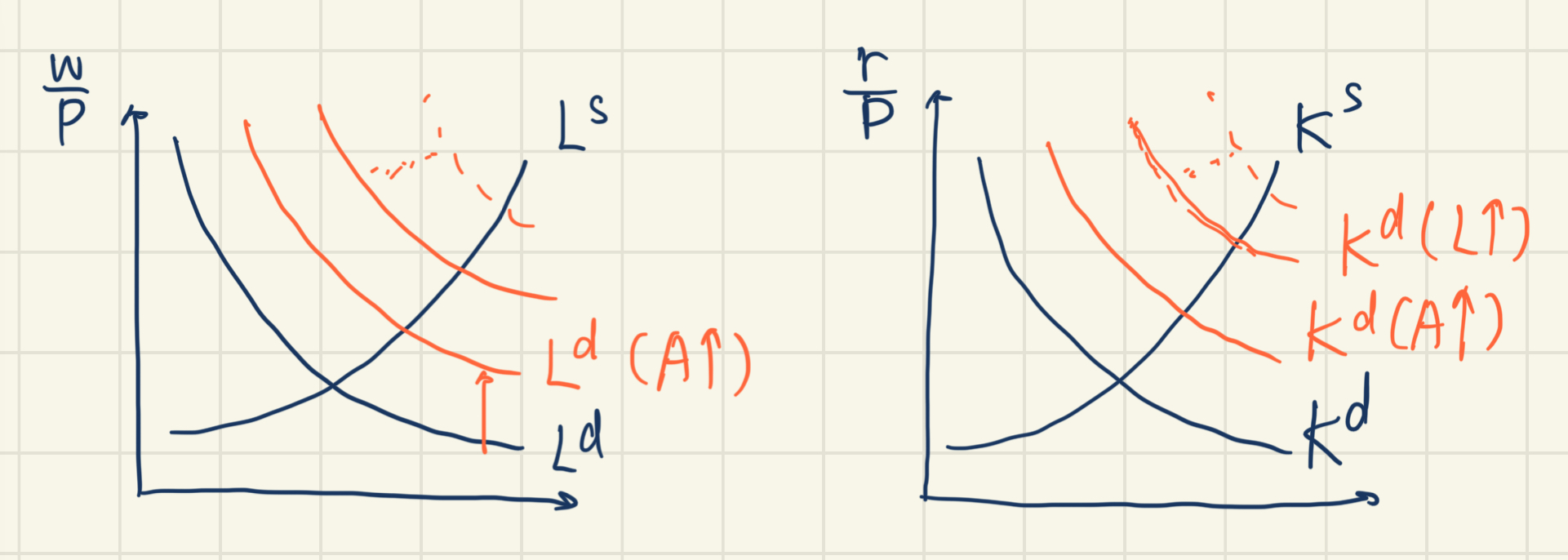
The intuition is that the process would be infinite, but finally the process would stop. (May because the productivity is limited)
- Labor Market:
- Supply Market:
- Output Market: , increases due to three reasons.
Lets try to draw the graph of output market is that since the doesn’t matter with price, we first consider the real variables:
What determines
We need to introduce money to the model. The quantity theory of money is:
is the level of money supply, is the Velocity of Money.
For simplicity, we set
So, is the demand function for ,
is the supply function for .
So the graph for output market would look like:
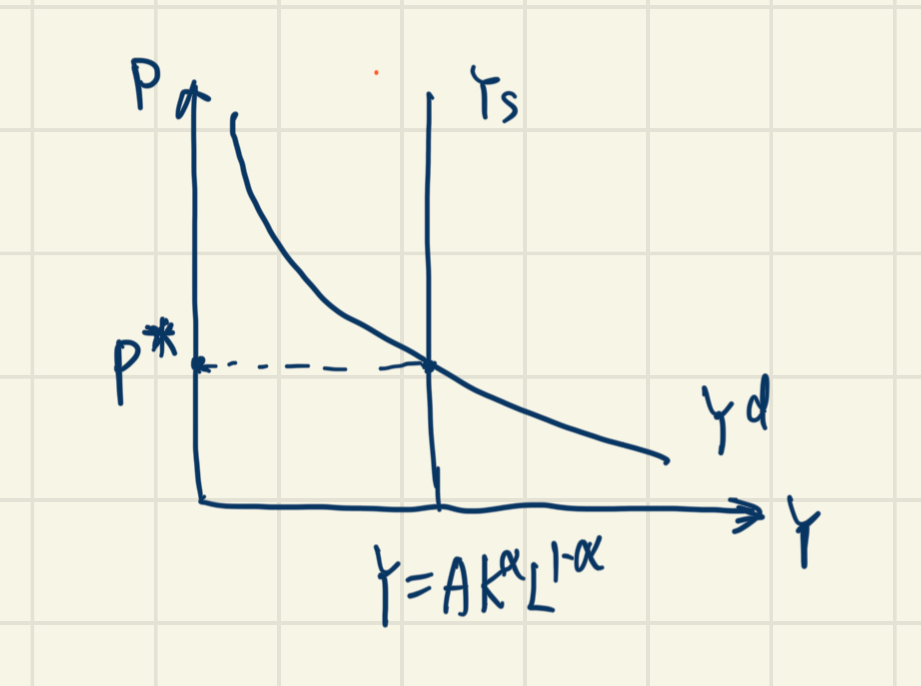
For example, when , the shift to the right, ,
In this economy, the money is neutral.
This is different from the IS-LM model because they are focusing on different time horizon. This is called monetary neutrality, which captures the long-run effects of monetary policy.
We could determine the variables separately.
Key assumption: All prices are fully flexible. So money supply have no effect.
Exercise
Derive the equilibrium expression for . Hint: , ,
For ,
Since , we could get:
For ,
We substitute :
Similarly, we could get
Classical Dichotomy
Quick Review
We used the labour market, the capital market and the production function to determine .
They are the real variables.
How about the nominal variables? ?
We use the quantity theory of money:
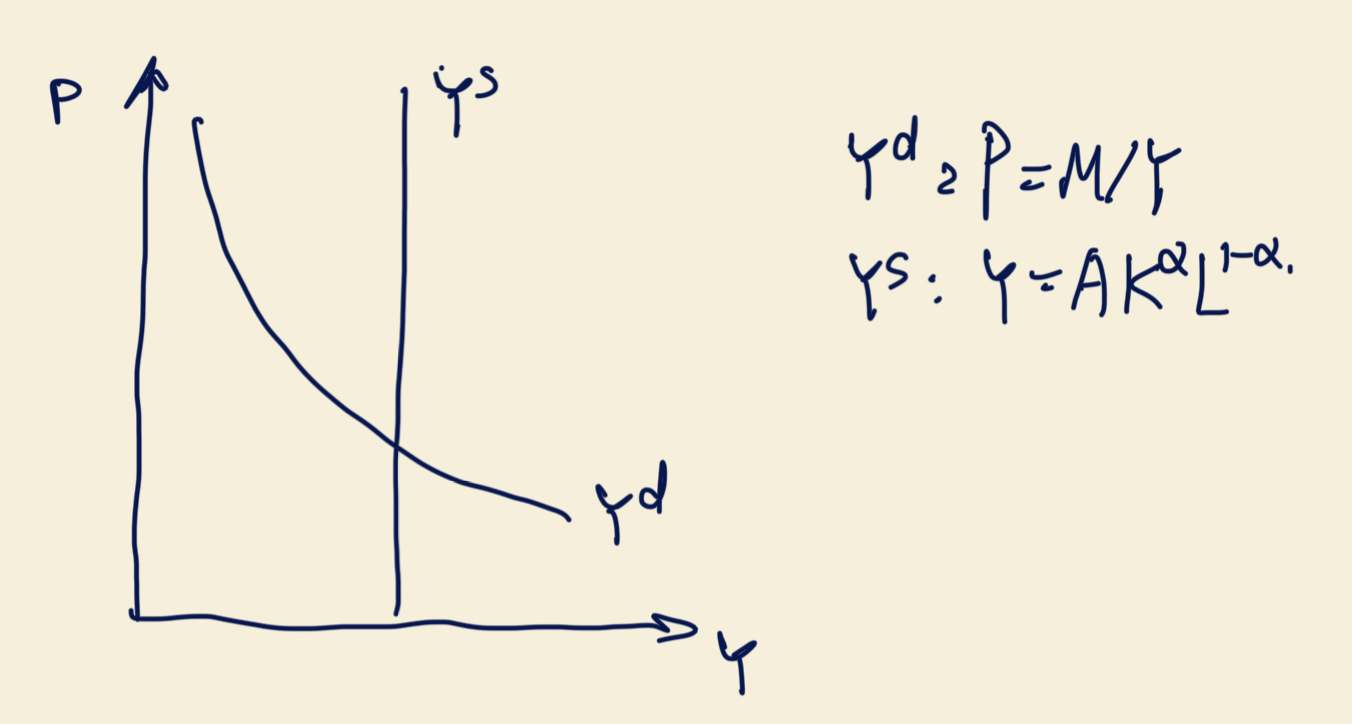
The reason we could make it is that money has no effect on the real economy. This is called monetary neutrality. We have monetary neutrality in this economy because all the prices are fully flexible. So, money only affects the nominal variables.
For example, we derive :
Summary
(Nominal variable)
However, has no effect on the real variables. Thus we have monetary neutrality due to flexible prices.
Chapter 2 The Neoclassical Growth Model
Now we want to define the supply side. We pick as the numeraire.()(计量标准)(Recall that the firms try to maximize the profit)
And Households supply labour inelastically: , so that is a parameter.
We allow for an elastic supply curve of capital. Households maximize utility to determine consumption and saving. Saving affect capital accumulation via capital investment.
Households
Households maximize utility.
The reason we choose this function is because it has some nice properties:
- Diminishing Marginal Utility (It is increasing in a decreasing way), that’s also the reason why we don’t use a simple linear function.
- If
We care about the lifetime utility function, then it is obvious that we could derive the utility function:
People discount the future utility. We then introduce the discount rate . (recall Game Theory)
So the lifetime utility is:
And we approximate by
This is a discrete-time model. However, time is a continuous variable, we want to convert the discrete-time utility function into a continuous-time utility function by replacing the summation sign with an integral sign.
Thus the households’ objective is
Without the constraint, the best way for us is to take in every period. In reality, the households faces budget constraint
Hamiltonian
Multiplier is for the asset-accumulation equation.
The word “Saving” here is flow, not stock (saving in your bank).
For consumers, and we denote consumption by , and saving by (Capital Investment), because we assume that capital is the only productive asset in the economy. Investment today becomes capital in the future.
记住大 一般代表的就是 consumption
So the question becomes: how we could balance the investment in the certain period? Then we introduce the hamiltonian:
We define:
So it’s trivial that
Recall that our objective is the Households’ optimization problem
We will use a mathematical tool, known as the Hamiltonian, to solve this dynamic optimization problem.
In general, we want to compute that:
Then we find the first-order condition:
- is a multiplier (or a costate variable)
- is a predetermined variable (or a state variable)
- is a jump variable
Then we try to manipulate FOCs:
Similarly,
That means:
Recall the equation:
We get:
This is the optimal path of consumption chosen by the household.
We could also write it as:
This is the optimal consumption growth rate.
- If , then
Intuitively speaking, if the return to capital () is high, then the optimal behavior is to save more and consume less today. So, the household’s consumption is rising overtime.
We save for future consumption
Firms
To find the equilibrium, we need both the decisions from firms and Households. For households, we need to maximize the profit. And typically we use the Cobb-Douglas Production Function in practice:
For a firm, its profit = revenue () minus its cost, which is , so
Take the first order condition:
The important thing is to notice the and .
The Steady State Equilibrium
Recall from the households, we already find that in steady state,
. In the function, we also have a function with
So
Finally we could get the , where
Recall that we have fixed the , so from the equations, the change in and are those who determine the behavior of the economy.
At the steady state ()
We could put it back into the production function, then we get:
At the steady state ,
that . In this special case, we assume no depreciation rate (), so that
Chapter 3 Dynamics in the Neoclassical Growth Model
Recall that the Steady State means that we capture the long-run effect, but it’s not enough.
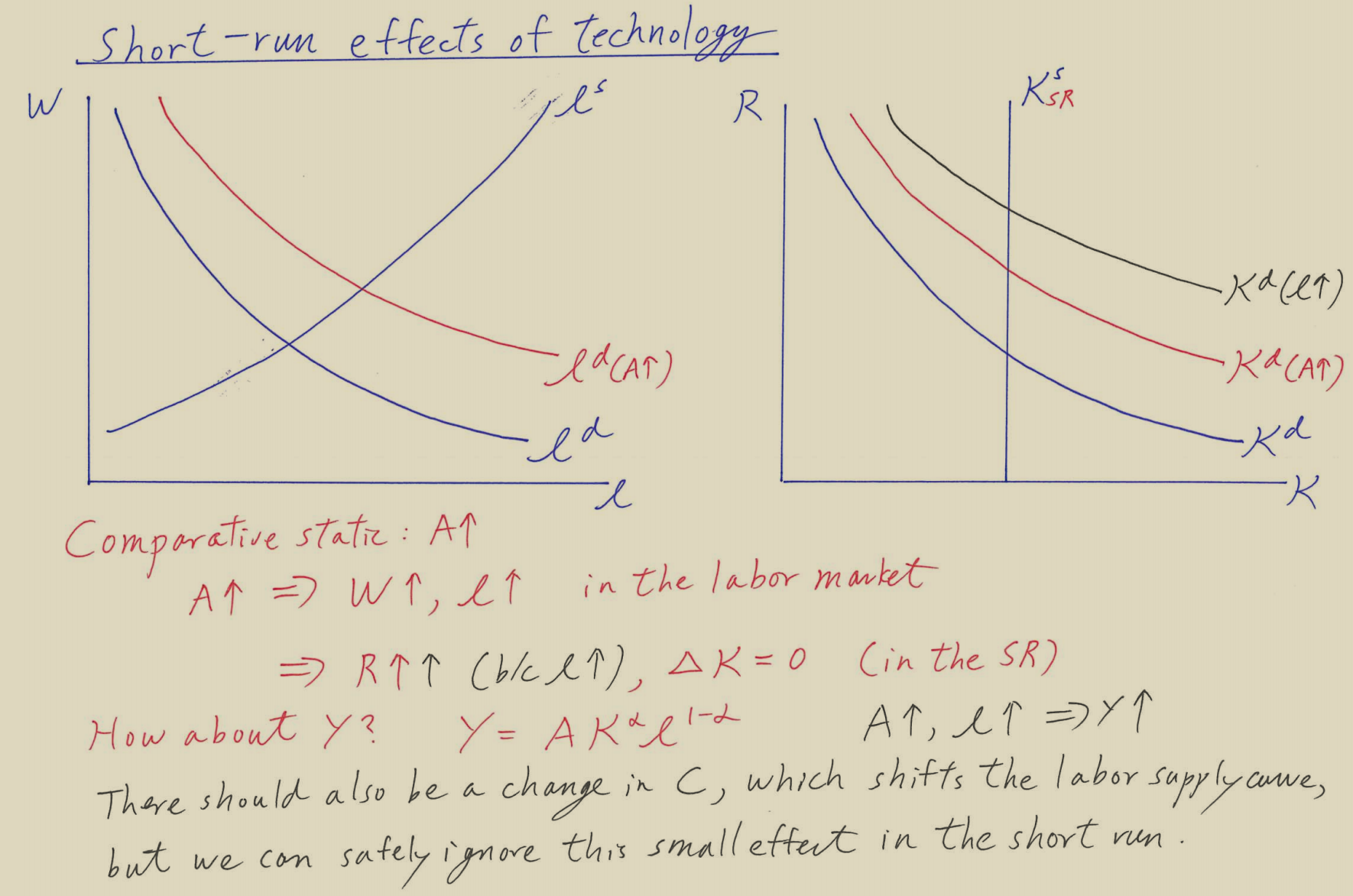
In this chapter, we try to study the short-run effects in the change in technology .
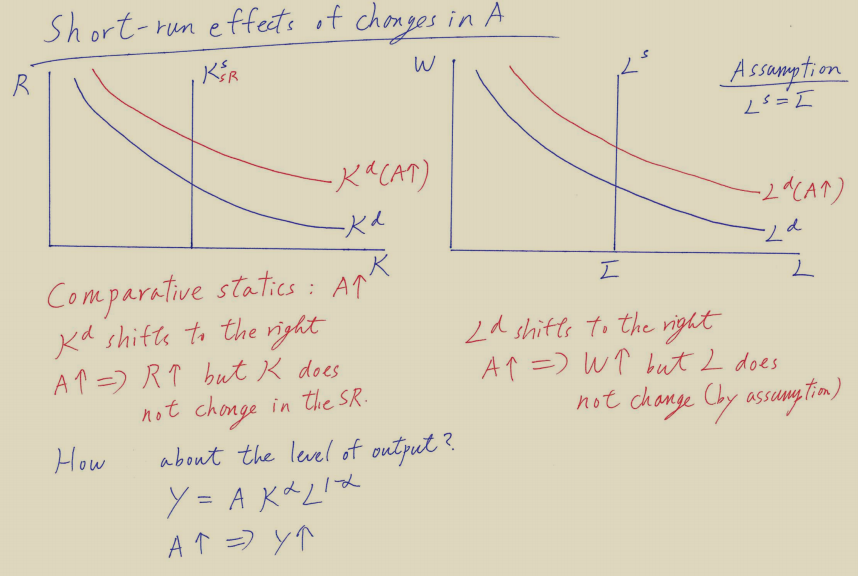
- Why the short-run supply curve of capital is vertical?
Because at the moment when changes, the level of capital in the economy is predetermined and cannot change immediately.
Also, notice that we assume a perfectly inelastic labour supply, so the labour supply curve is also vertical.
Short-Run Effects of Technology
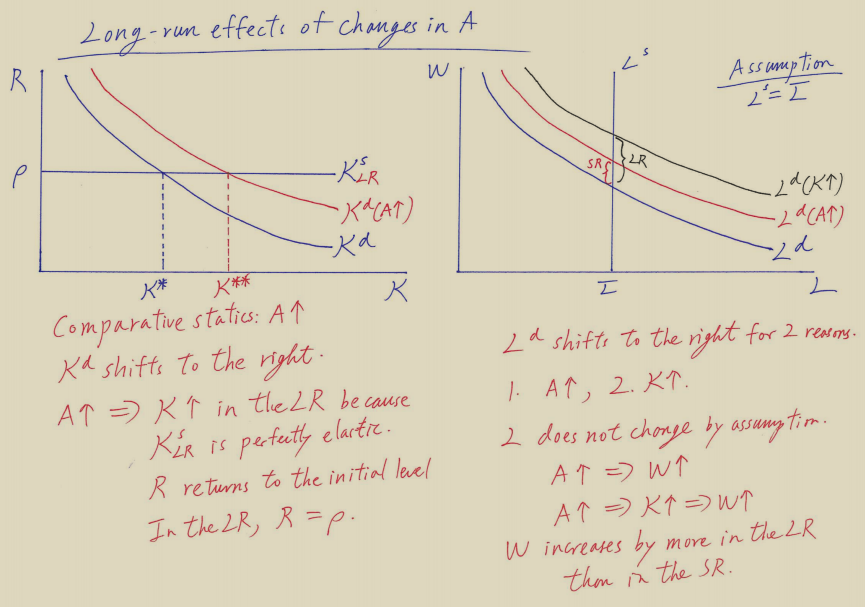
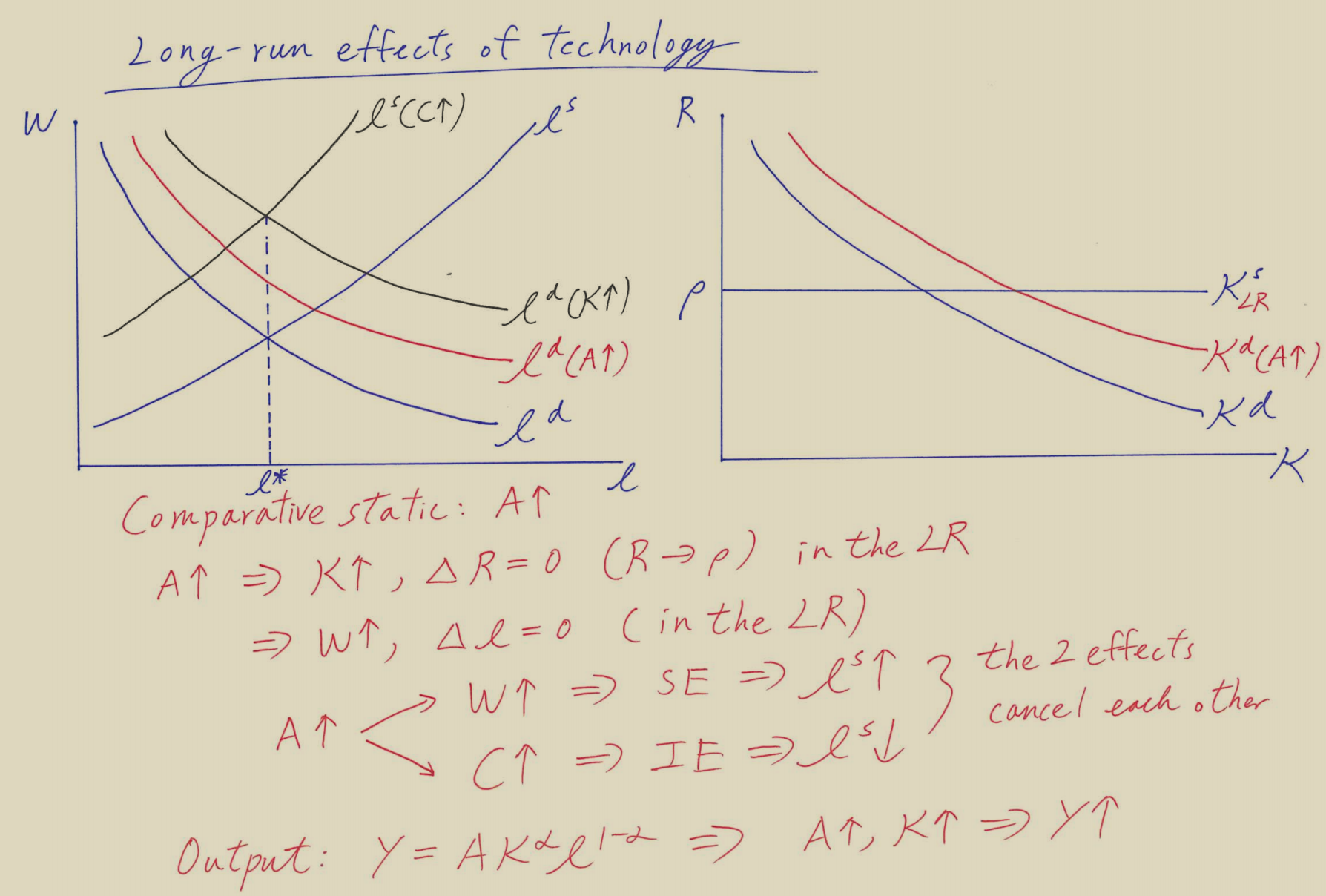
Long-Run Effects of Technology
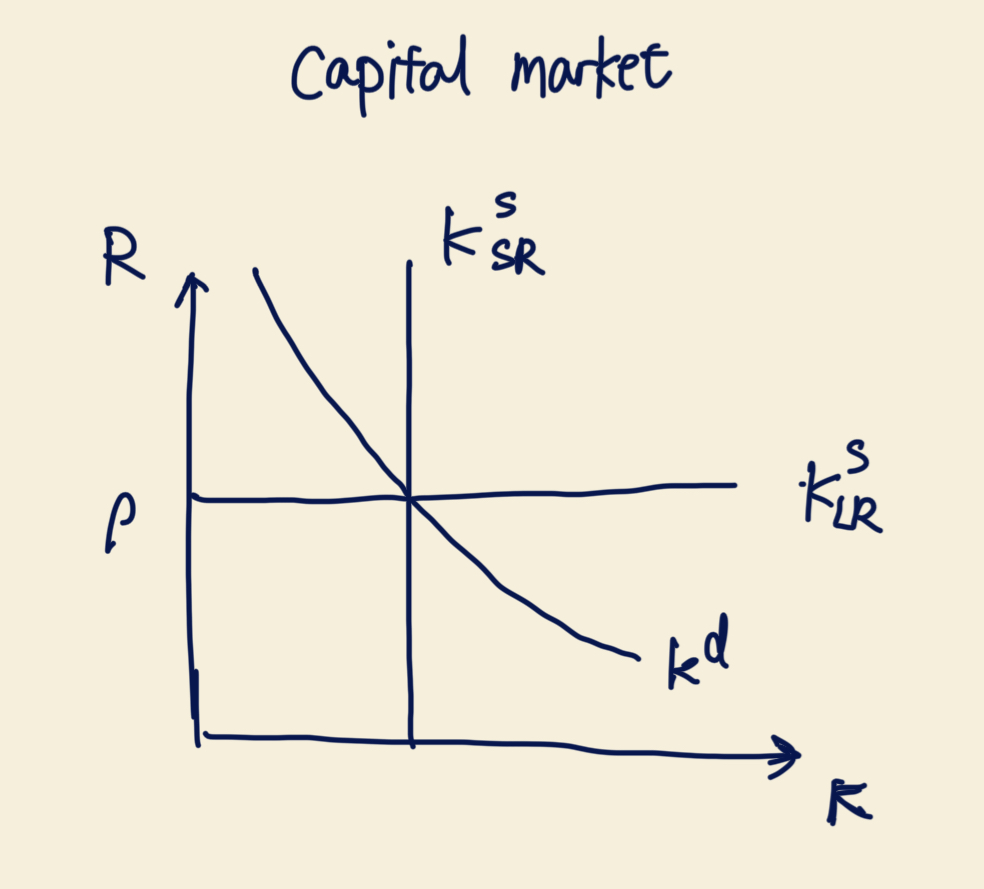
The long-run capital supply curve
Recall that Steady state means long-run equilibrium.
All variables remain constant:
So that in the long-run, the capital supply is a horizontal line, . The intuition is that is a constant, and it won’t change. We are looking at the case when it is long-run. So we make sure , which is a horizontal line.
- , it will be a horizontal line (perfectly elastic)
In the short-run, the supply would be perfectly inelastic, because is predetermined variable
What happens to output?
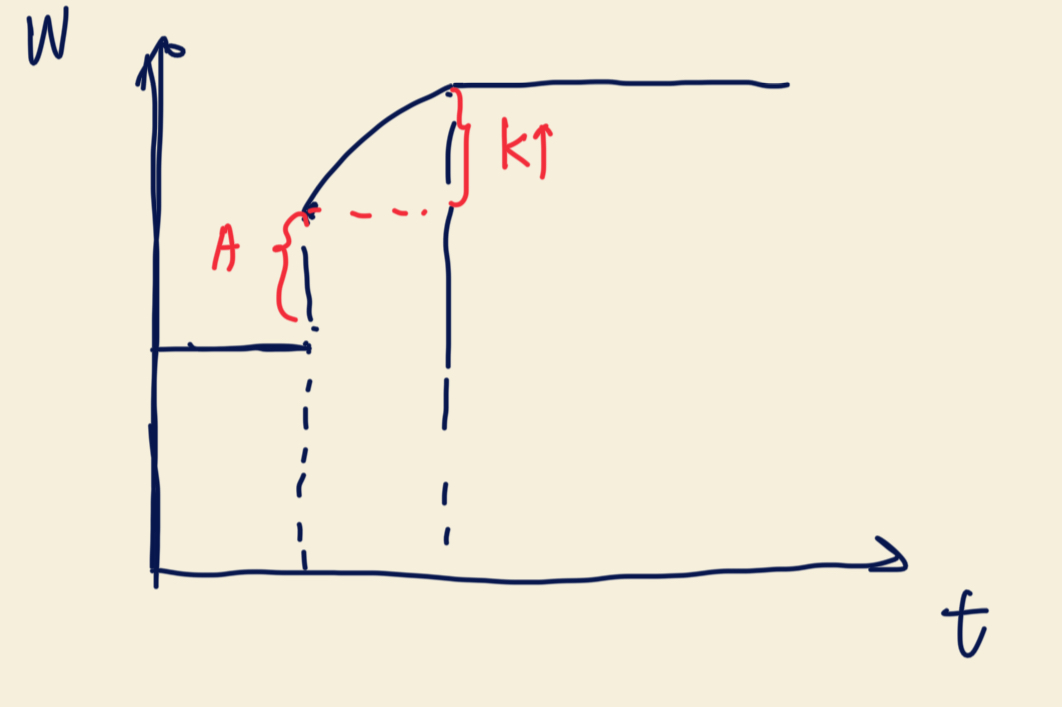
increase for 2 reasons.
Exercise
Question: Derive the steady-state level of capital. Show that
Hint: Combine and
Comparative static: .
In the SR, and remains at at this moment. Overtime, gradually increases, and gradually decreases.
In the LR, and return to .
In the SR,
The household reduces current consumption and increases saving, so that capital investment goes up.
The time path
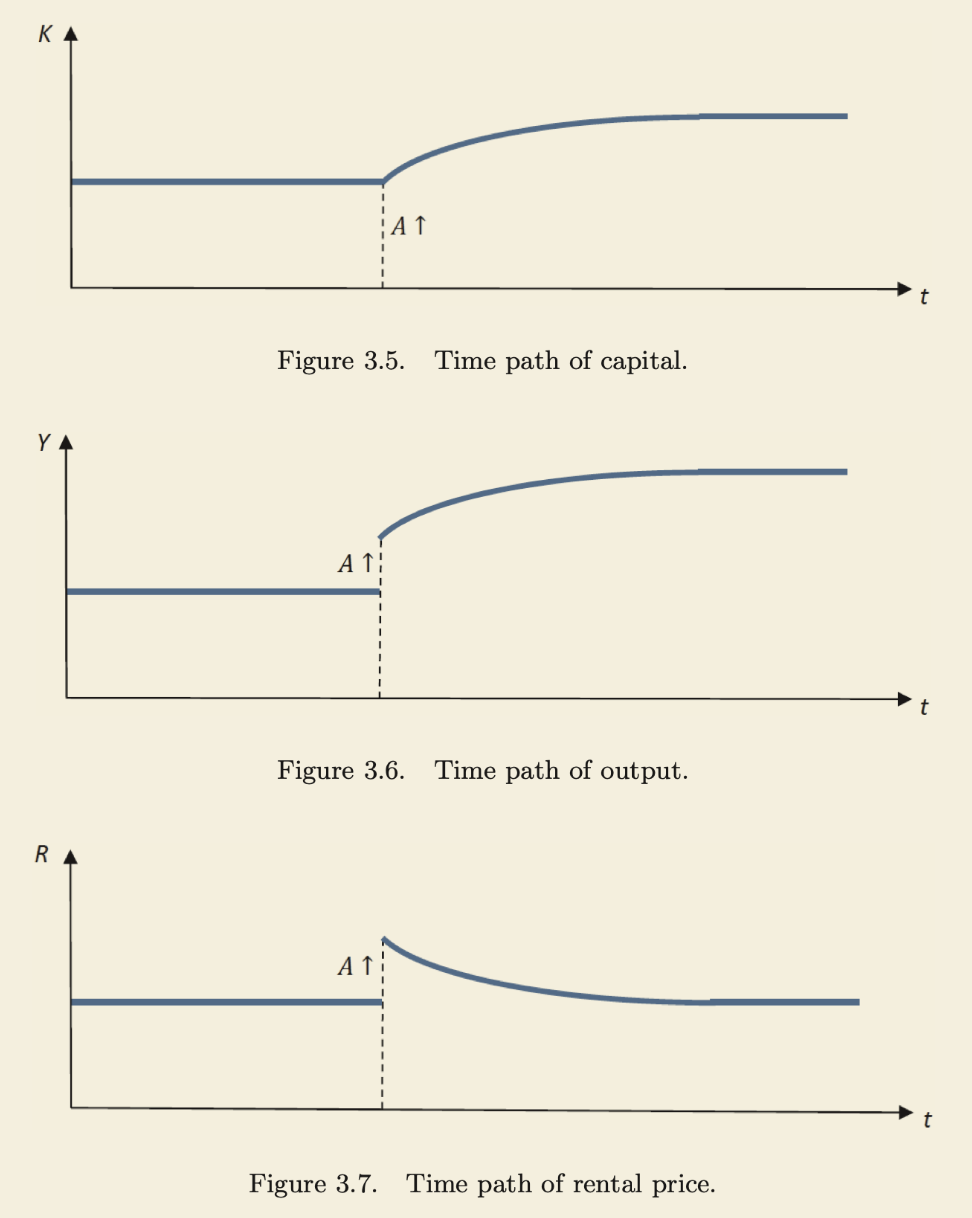
Note that the shape of is concavely decrease.
In the labor market, recall that
Real Business Cycles model, Kyland and Prescott won a Nobel prize for developing the RBC model
Exercise
s.t.
is the capital depreciation rate.
Use Hamiltonian to solve it:
IMPORTANT: We should take the derivative for and , and then we could get
Optimal Consumption Path
If the net return to capital is high relative to the household subjective discount rate (how patient it is), then the household wants to invest more in capital. As a result, consumption is lower today and rising overtime.
Chapter 4 The Neoclassical Growth Model with Elastic Labour Supply
What’s the disadvantages in Chapter 3 is that We made a very ‘hard’ assumption, that the labour is perfectly inelastic. In this chapter, we try to generalize it.
Households
We consider a background info.
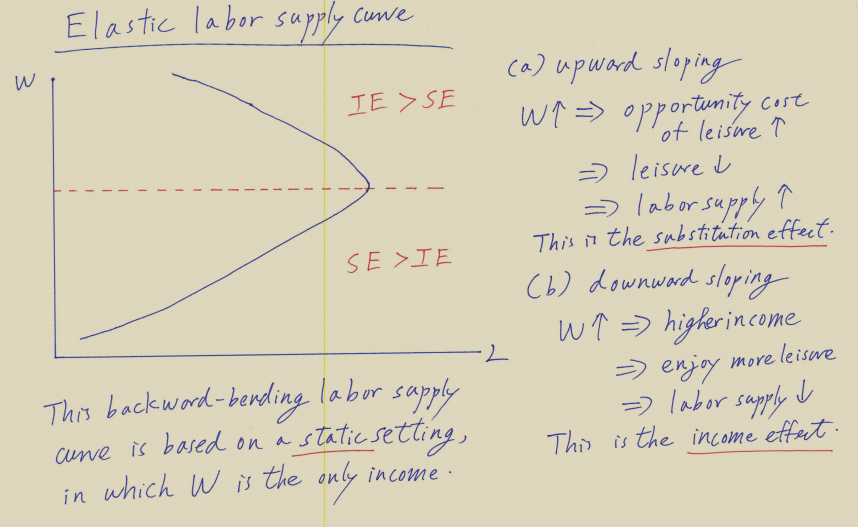
The supply of labour is basically determined by two aspects: the Substitution Effect and the Income Effect.
In this setting, we introduce a new variable, as “Employment”.
Since the total labor is , the leisure the households enjoy now is . and we have also introduce , which is the leisure preference parameter. The higher the , the more the households would like to leisure.
Recall that the households would like to maximize their utility:
s.t.
Hamiltonian
We can do the Hamiltonian again and then get:
These two terms are the same, however, as for the labour,
We could then derive the labour supply curve as:
Some intuitions behind it:
- When , then
- When , then . It shows the properties of .
The wage shows the Substitution Effect. Because from the Hamiltonian, we see that . It is the marginal utility of leisure. We fix , then when increases, the Opportunity Cost of leisure increases, and then the household would like to supply more labour. And this is the Substitution Effect.
We could see that is a function of and . The formal one is the Income Effect because it is a function of current and future income. So it could capture the entire Income Effect.
We first fix , from , when increases, decreases. Recall the function: , since decreases, what’s most important is that is directly the Marginal Utility of Leisure (Same as how we derive , , etc.) So also decreases.
Firms
The only things that changes in the function is to .
That the Cobb-Douglas Production Function becomes:
So does the profit function .
Short-Run Effect on Technology
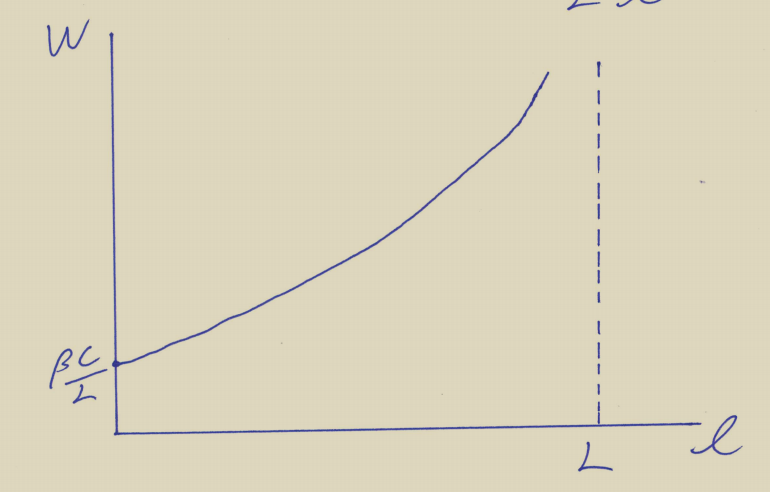
The labour supply curve now is given by:
which is upward-sloping.
The Midterm Exam would cover from Ch1-Ch7
- Do the Math
- Do the Graph
Economic Growth
- Highest GDP per capita > \100k$ (PPP adjusted)
Examples: Macau (\130k$148k$ 151k$)
- Lowest GDP per capita: ~ \ 1k$
Examples: South Sudan: (\760$1300$)
Fact 1: Income Differences across countries are extremely large and can be over 100 times between the richest and poorest economies in the world.
Simple Example
| Country | 1820 | 2020 |
|---|---|---|
| A | \1000g=1%$ | \7000$ |
| B | \1000g=2%$ | \52000$ |
Fact 2: A small growth differential accumulated over a very long period of time can lead to large income differences.
It has combination of:
Growth in output must come from growth in the inputs.
Some notations:
- : output
Proximate Causes:
- : technology - technology progress
- : capital - capital accumulation
- : labor - population growth
- : natural resources -discovery
- : human capital - education
Those factors would lead to economic growth in .
Fundamental Causes
- Institutions eg. property rights
- Geography eg. international trade
- Culture: eg. saving/eduction
- Luck eg. natural resources
Solow Model
See the notes above.
Midterm: Neoclassical model and application
Some Questions for ECON4004 (Todo)
- Is Capital = Saving = Investment in Neoclassical Growth Model?
Sample Exam Question Self-Answer
Question: Discuss the Neoclassical growth model with elastic labour supply and apply it to demonstrate the short-run and long-run effects of an increase in the government-spending ratio (financed by a lump-sum tax) on the economy. How would your results change if labour supply were perfectly inelastic?
We define that as the government-spending ratio.
Final Review
- Chapter 9: Solow Model
- Chapter 10-12: Ramsey Model
- Chapter 13: Romer Model