It’s the simplest model introduced in the International Trade
Essential Ingredients
Production Possibilities Frontier
Definition: a curve showing the possible quantities that can be produced given technology and factor endowments. The slope of this should be the Opportunity Cost of producing a unit of quantity of goods (using to represent), if the PPF is linear, that means the marginal product is constant.
text -> graph -> equation
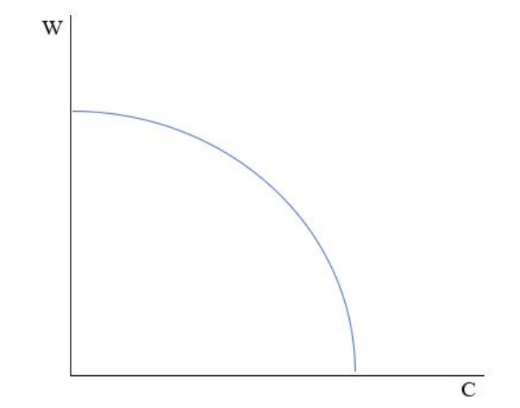
However, in the reality, the PPF curve might not be linear, the cost switch to another industry might be costly. The PPF below is bowed out so the MRS is increasing, to produce more , you have to give up much more , ( is wine and is chips)
Graphically Example
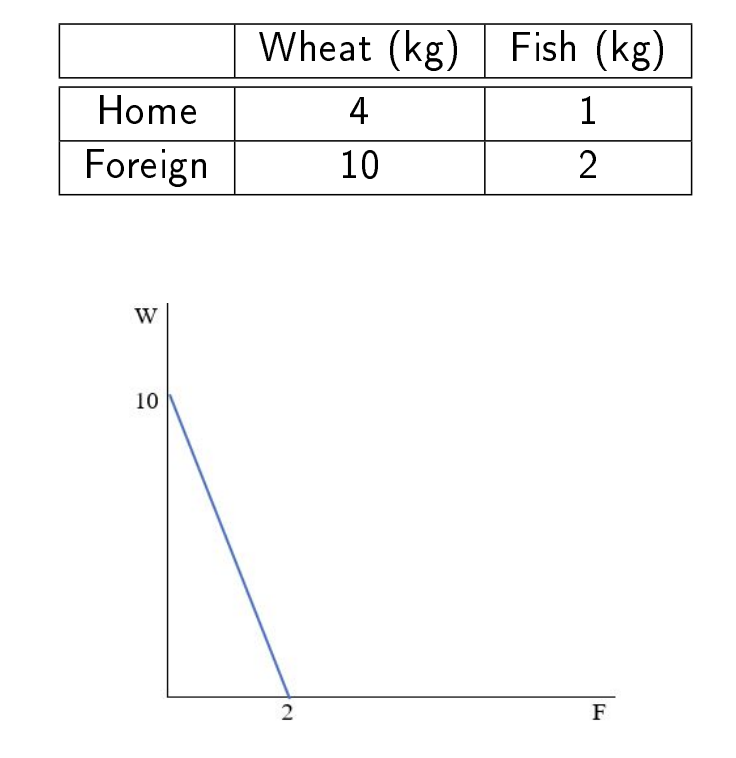
When we allocate all the materials in the Wheat, we should produce 10. The reason why the curve isn’t bowed out is that we didn’t make too much assumption here.
Simple Conclusion: PPF shows various combinations of the amounts of two goods which can be produced. But, to know the exactly the combination of two goods that will be actually produced, we should know the demand for each of the two goods.
Indifference Curve
Definition: A curve showing various combinations of two goods that leave the consumer equally satisfied (equally utility)
Also recall the definition of the and
Above are the intro part of the course.
Ricardian Model
Basic Setting: 2 countries, 2 sector, 1 factor (labor) model
There are some typical assumption of the Ricardian Model:
- The technology is given (but of course differs between countries), in another word, the labor productivity is different among countries. Also, the technology is Constant Return to Scale production. It is described by a unit labor requirement.
- Aggregate endowment of labor is fixed.
- Completely immobile across countries, but completely mobile within a country and between sectors. (workers are free to choose which industry to join in their home country)
- Wage is determined in a national labor market
- Labor market is perfectly competitive
- In equilibrium, wage must be equalized across sectors
From GPT:
- 只有一个生产要素:模型假定劳动是唯一的生产要素。
- 不同的生产率:不同国家生产相同商品的劳动生产率(劳动效率)不同。
- 恒定的回报:生产中有恒定的劳动生产率,意味着无论生产多少单位产品,每单位产品所需的劳动量是固定的。
- 固定的技术:所有国家使用的生产技术是固定的,并且在短期内不会改变。
- 完全竞争市场:存在完全竞争,没有交易成本,没有运输成本,没有技术障碍。
- 劳动力流动性:国内劳动力可以自由流动,但国际劳动力流动性为零。
Now, focusing on the equilibrium of Home and Foreign economy
First, lets consider the Home Side:
Assume the IC is given.
Let and denote the unit labor requirements for and production, so the , notice that since we assume that the labor endowment is fixed.
So we could write the constraint:
So the Home PPF:
Slope:
So, when in the Autarky Equilibrium, that means there are no other foreign countries. The equilibrium would meet at the intercept point between and
Wage
In competitive labor markets, rms hire workers up to the point where the cost of one more worker equals the value of one more worker. . And under the assumption of the free movement of labor (see our main assumption)
Now, we gonna lead in the Foreign part.
Assume that the Foreign is more productive than Home in both sectors and : , where
The assume that Foreign has a comparative advantage in producing :
The foreign would have a different PPF graph. (mainly different slope of PPF), the Autarky Equilibrium would also differs.
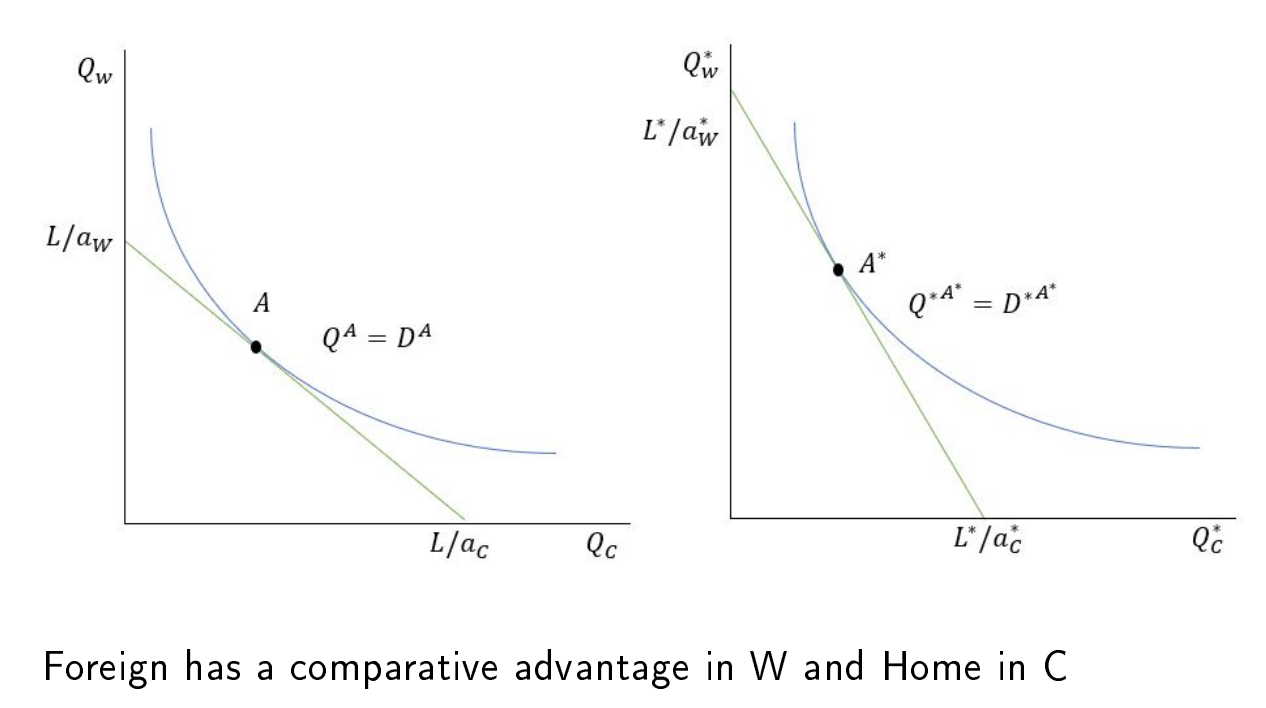
After knowing that, we would gonna consider the International Trade.
Equilibrium , under trade
World relative price: since the market is Perfect Competition.
- If , then both countries specialize in W
- If , then both countries specialize in C
- If , then Home specializes in C and Foreign specializes in W
Country would only trade when the third case happen. This will lead to such result:
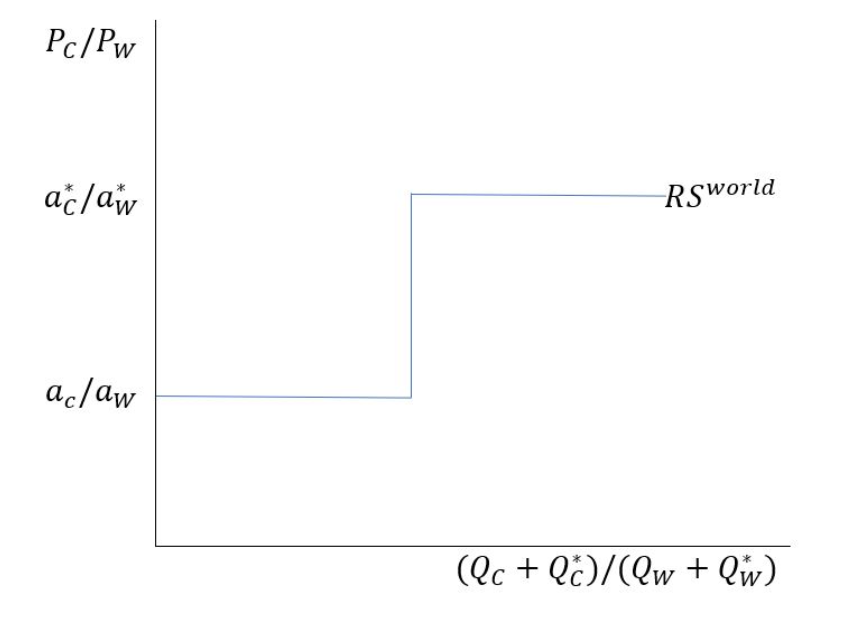
Assume that ,