Nash Bargaining involves Threat Values, Cooperative Surplus and Bargaining Power
Unlike the initial discussion about the Noncooperative Game Theory, the Nash Bargaining is a Cooperative Game Theory problem.
The famous example: Prisoner’s Dilemma
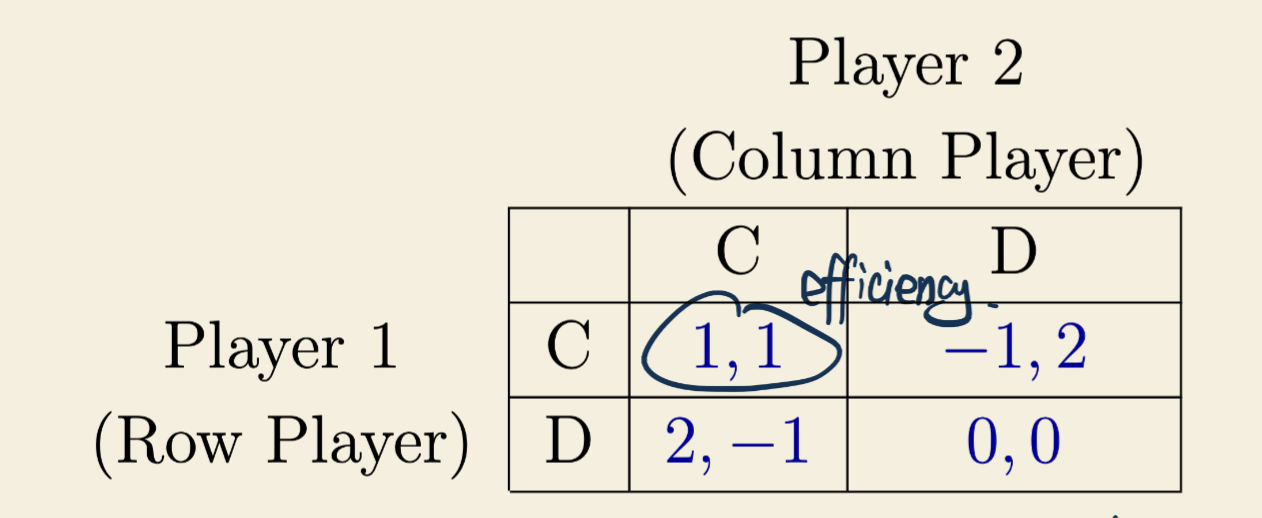
In the previous study in Nash Equilibrium, we know that the equilibrium happens in , which is not efficient ,that means people act non-cooperatively. But we know that in the Prisoner’s Dilemma, people do so is because they do not have Bargaining Power, if they could, they may reach the better outcome (efficiency).
In this case, the Threat Values would be , the Cooperative Surplus is . They could reach the efficient outcome by binding contract which is
Binding Contract means no cheating, everyone do as they say.
But this is the case happens when they have equal bargaining power , suppose player 1 has full Bargaining Power but player 2 has none. Then player 1 could ask player 2 to pay 0.999999 to him, since 0.000001 > -1, player 2 would agree the contract, in this case, player 1 get the full Cooperative Surplus.
The same is in the pollution problem.
Usually in such problems, we follow those steps:
- What happens in the efficient outcome? (when no rights allocation)
- What happens without bargaining?
- What is the Cooperative Surplus
- How about the results after bargaining?
- Provide the results.
The More formal explanation from EC487 Advanced Microeconomics
Definition: A bargaining problem is a tuple where:
- is a compact set of outcomes. It could be understood as the possible contracts that two companies could reach.
- are two continuous utility functions.
- is a disagreement outcome so that and for all .
The definition of to make it compact is saying that the outcome is bounded and closed, this allows us to find the maximum utility for both players. So this is an important assumption.
Definition The Nash Bargaining Solution to a bargaining problem is an outcome so that for all and
here means a threat point, suppose at the current state , player is not that satisfy with the current status, then he could propose a new , this deal could happen with probability , and with probability the deal fails and both players get the disagreement outcome . The definition says that if player could get a better outcome by proposing , then the other player would try to avoid this deal by making sure that his expected utility from the current state is higher than the expected utility from the new proposed deal .
Proposition is a Nash Bargaining Solution for if an only if
Proof
From definition, we could easily have and for any . Thus it is wlog to assume that .
() Suppose is a Nash Bargaining Solution, which is . Suppose that there exists one such that .
It’s obvious at least one player is better off. Also wlog that we assume it is player , which means . Then we have
where .
By the definition of Nash Bargaining, we have
Thus by definition, it is not a Nash Bargaining Solution, which contradicts our assumption.
() Suppose we have , we want to show it is the Nash Bargaining solution.
Since , we have
Consider a such that
Thus we have:
Since we have