Statistics MOC #fleeting Statistics
Application
- The problem objective is to compare 2 or more populations
- The data are either ordinal or interval, but nonnormal
- The samples are independent
The application of Kruskal Wallis Test and Friedman Test are all for non-parameters test, but they differ in their application scenarios and test statistics. The Key difference is that the experimental design is independent samples and randomized blocks
Hypothesis
: The locations of all populations are the same. : At least two population locations differ.
Test Statistic
The test statistic of KW, is denoted by , and the equation is
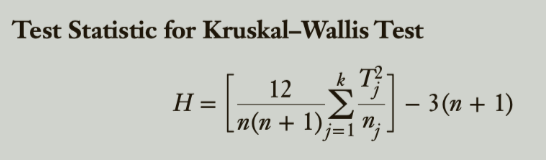 If the rank sum is similar, the test statistic will be small.
The smaller the H, the
If the rank sum is similar, the test statistic will be small.
The smaller the H, the
Sampling distribution
The distribution of the test statistic can be derived in the same way in Wilcoxon Signed Rank Sum Test
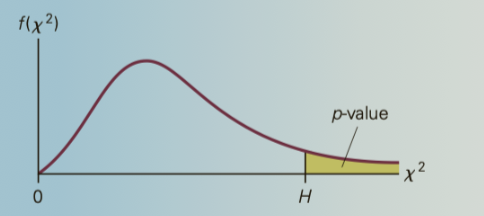
When the sample size small (smaller than 5), we could just easily list all the content. But when the sample size is larger than 5, the test statistic is approximately like the one in Chi-squared Distribution
The rejection region
What is the difference between Wilcoxon Signed Rank Sum Test?
The KW method could produce the same result to the Wilcoxon Signed Rank Sum Test as the two-tail case, but it could only determine whether the difference exist (), to determine whether it is at right or left, we still need to use Wilcoxon Signed Rank Sum Test