Here is an example of the iterated dominance:
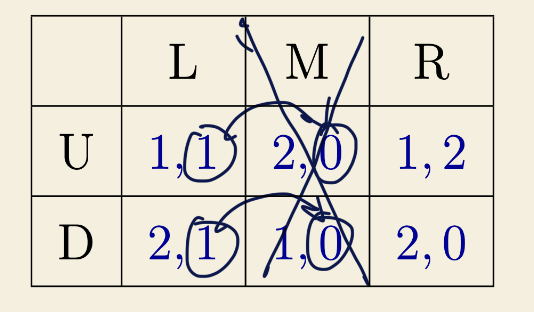
Step 1: It can be verified that for player 2, strictly dominates , so we delete
Step 2: Then, we could recognize that for player 1, strictly dominates , so we delete .
Step 3: Now, for player 2, strictly dominates , so we delete .
Another Example
| L | C | R | |
|---|---|---|---|
| U | 4,3 | 5,1 | 6,2 |
| M | 2,1 | 8,4 | 3,6 |
| D | 3,0 | 9,6 | 2,8 |
The method is the same, At first, we could find for player 2, strictly dominates , so we delete column :
| L | R | |
|---|---|---|
| U | 4,3 | 6,2 |
| M | 2,1 | 3,6 |
| D | 3,0 | 2,8 |
Now, we could find strictly dominates and , we delete them:
| L | R | |
|---|---|---|
| U | 4,3 | 6,2 |
| dominates , |
| L | |
|---|---|
| U | 4,3 |
The final strategy pair is
The payoff is .
The intuition here is that the outcome of the Iterated Dominance is irrelevant to the order of deletion. That means, no matter how we delete the rows or the columns (only if we are correct), the dominated strategy won’t be into an undominated ones.
The key idea is Delete all strictly dominated strategies