Definition
A merger involves a combination of two companies that were previously separately owned. A merger may or may not directly result in changes in the set of products offered to consumers.
Horizontal Merger exists between two or more firms with similar products
Shareholder: 股票持有人
Williamsonian Trade-Off
The model setting:
- Perfect Competition with of , price .
- Monopoly with marginal costs of , price
You could simply understand in the way that before Merger happens, it is perfect competition, but after that, the market becomes the monopoly.
We focus on the procedure from Perfect Competition to a Monopoly. And we could compare the DWL:
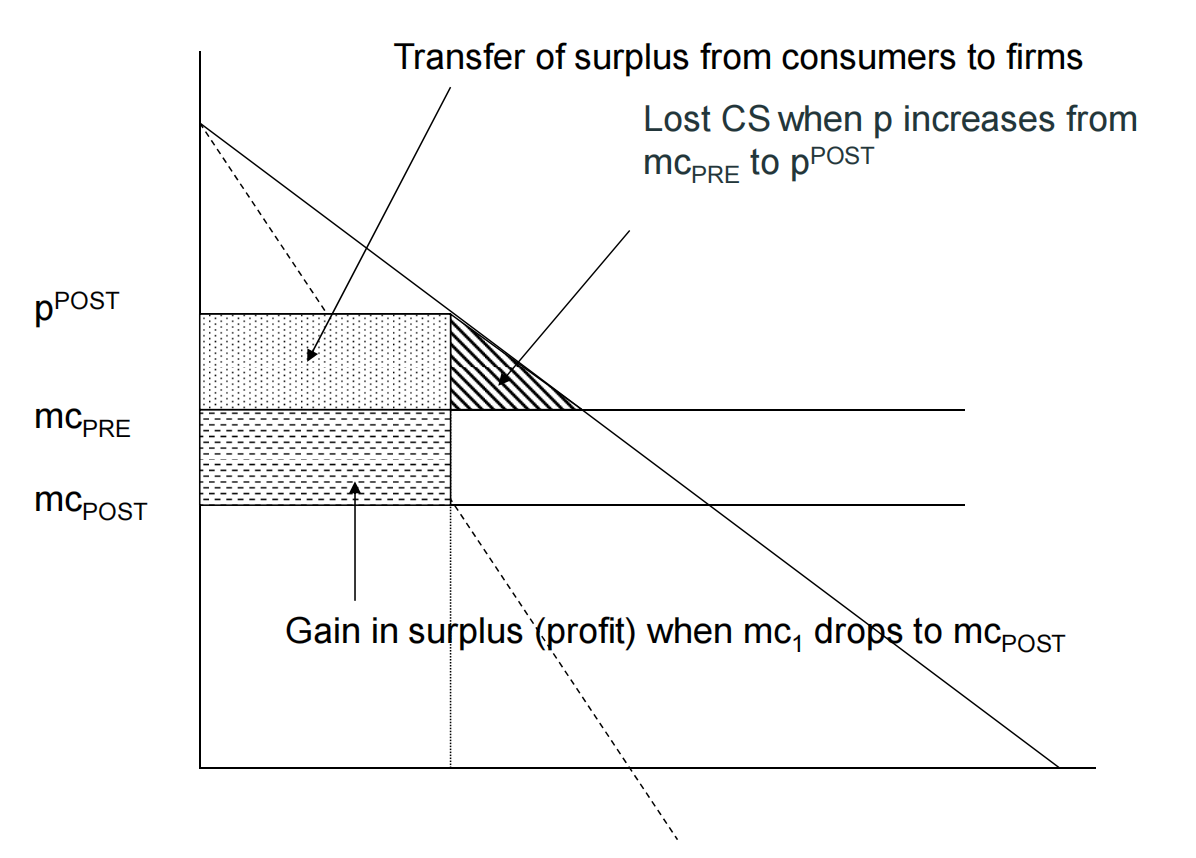
The limit of this theory is that we made the assumption that before merger it is the Perfect Competition. What is then should be considered is the Cournot
Post-Merger Outcome with No Marginal Cost Efficiencies
Theorem: (We skip the calculation part)
The profits of each of the non-merging firms increase after a Cournot Merger with no synergies
We could then conclude that the total profits of the merging firms only increase after a two-firm Cournot merger with no synergies if .
However, since must be an integer, when , and a two-firm merger happens, the industry would switch from a Duopoly to a Monopoly, therefore, in a world with constant and identical marginal costs, Cournot competition and more than three firms a merger between just two of the firms is unprofitable for the merging firms.
The main reason for that is mainly because it is related to the fact that Cournot competition involves strategic substitutes.