The Cobweb Model, or cobweb model, is a model in economics that describes the process by which prices and output adjust over time in certain markets, and it is particularly applicable to markets where there is a time lag in supply and demand responses. In the labor market, the Cobweb Model can be used to explain how wages and employment levels interact and adjust over time.
The Cobweb Model of Labor Market Adjustment
The Basic Model
If the wage rate goes up suddenly in a given year, the supply of graduate related students would not be affected until 3 or 4 years later (owing to the time it takes to learn the field). The basic model is like this:
If , it would be too hard to analyze, so let set .
Accordingly, employment level may be based on the last period’s wage rate. We suppose that supply function is given by:
In a numerical example
Lets say Labour Demand: Labor Supply: , .
In the LR, , so we could find the LR equilibrium: ,
But actually it is a iterated period. We have to calculated period 1, period 2 and so on. It does no immediately move to the equilibrium.
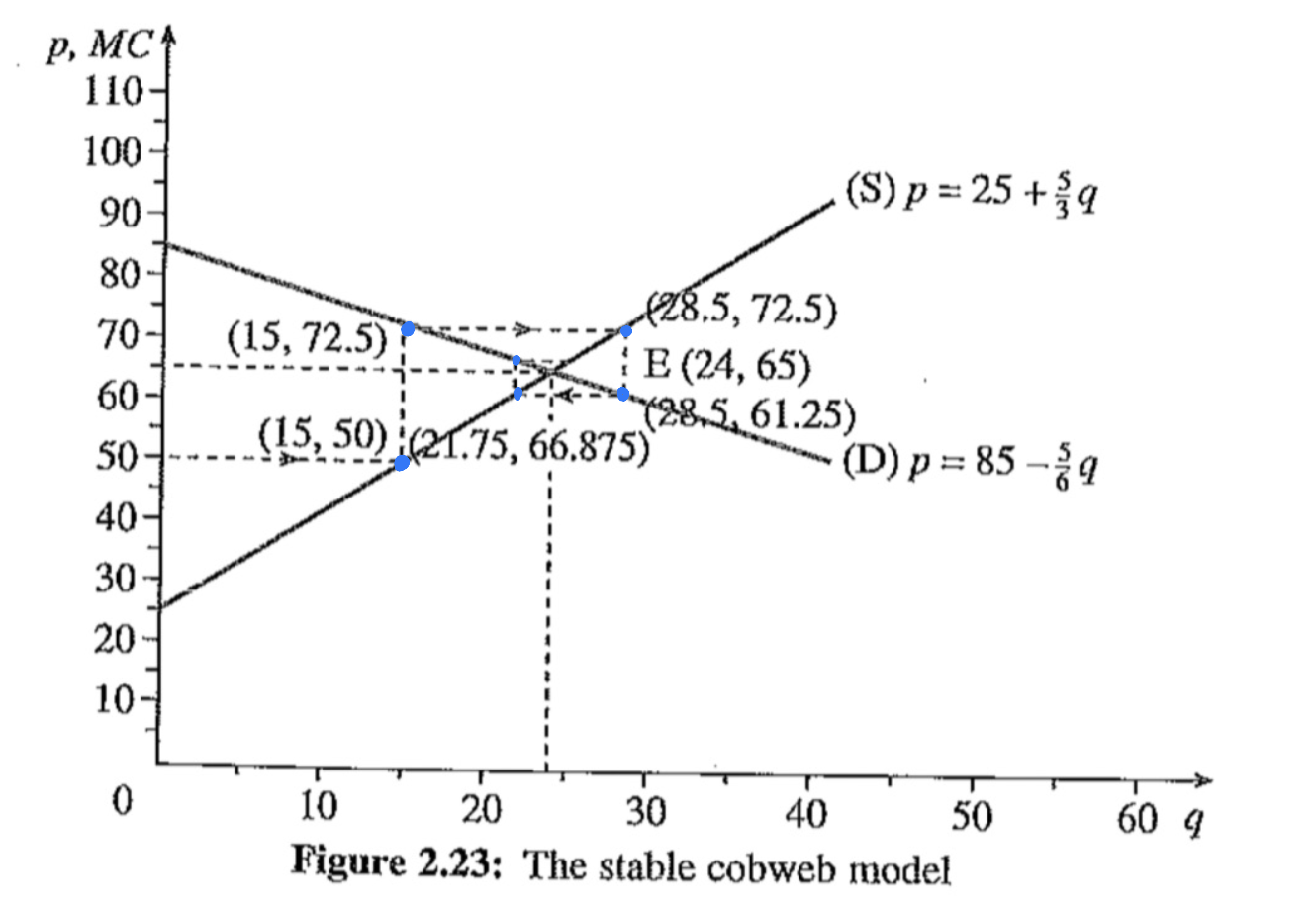
Definitions & Stability Conditions of Difference Equations
The First Order Difference Equation
In general (equation):
This is the first order difference equation. In the case of a Cobweb Model,
Demand:
Supply:
In equilibrium,
So, We could conclude that: , , .
Stability Conditions:
If Stable