Lecture 1 Review on ECON2003 Intermediate Microeconomics II
An equilibrium can be in 2 steps:
Step 1: Derive the Best Response, we set the unchanged, and find out how firm 1 react to maximize its profit. () , that is , stands for cost.
Usually, is the best response to
Another case: The Cournot Equilibrium under Monopoly case.
The key trade off is: More sales vs. lower price
Since the Monopoly price is quite high, so the firms are all willing to sell more.
Call back to the Perfect Competition, , that means,
And the result would be,
However, for the social welfare, the Perfect Competition performs best.
Merger is good for the firms.
Bertrand Competition
How about the firms compete in price?
In Bertrand Model, is the Nash Equilibrium the firm’s profit is zero in the equilibrium. Similar to Perfect Competition
Since the product are the same (the assumption is so), the firms all have incentive to increase the market share from to .
Introducing the product differentiation would solve this problem.
The Cournot Equilibrium vs. Bertrand Model
This was also mentioned in ^210420
Then consider a stylized Hotelling Model
Dynamic Games
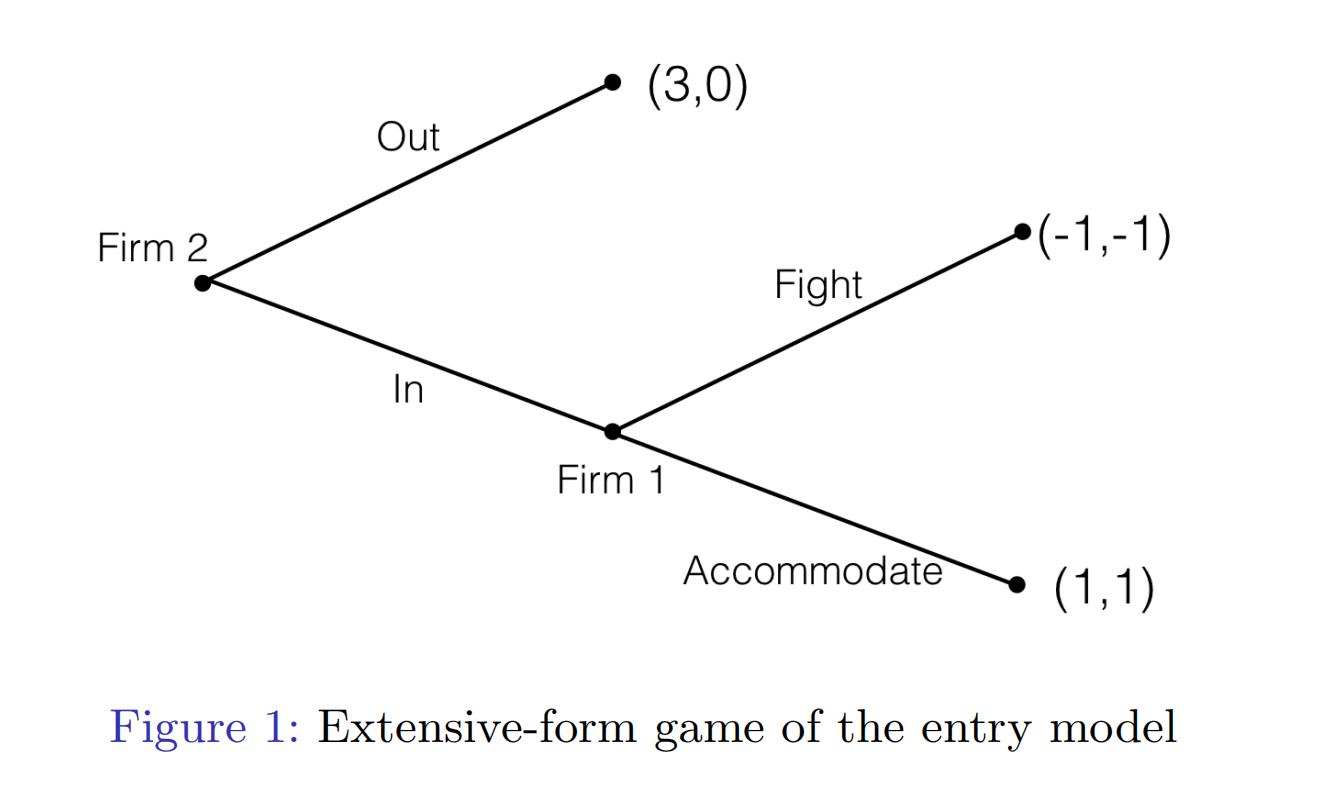
Usually we use the backward induction to solve the problem. And the solution is called the Subgame Perfect Nash Equilibrium.
Example of the Entry Model.
The Centipede Game
How about the Centipede Game?
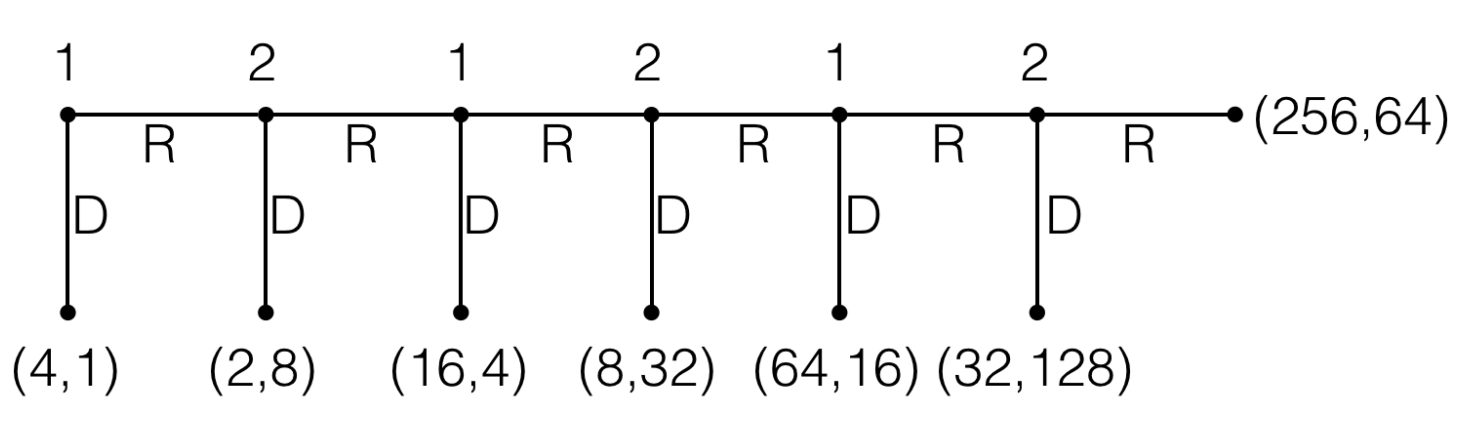 As learned before, the unique equilibrium outcome would be the player one to choose at the first move, and the whole game ends.
The bargain problem
Approach to analyze the Legal Rules:
- Step 1: What happens in the efficient outcome? (This does not depend on the allocation of the legal rights.)
- Step 2: What happens without bargaining (threat values.)
- Step 3: What is the Cooperative Surplus?
- Step 4: What are the final payoffs after bargaining? Given equal bargaining power, each party is better off by half of the cooperative surplus.*
- Step 5: Work out the corresponding price/transfer.