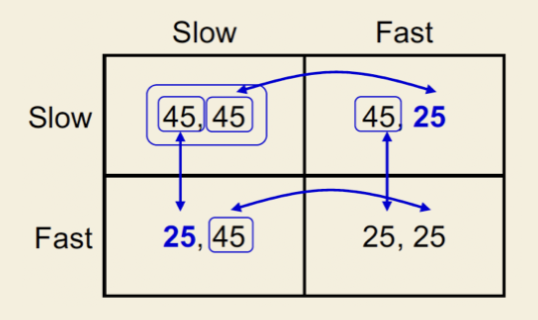
The example case is in the Hammonds v. Central Kentucky Natural Gas Co.
There are \100$ of gas, and two companies are competing for maximize their utility, where they could choose whether to drill fast or slow.
While slow costs \5$25$. If they are on the same speed, they share their outcome.
Here, if we use the way that is First Possession, the situation would become this:
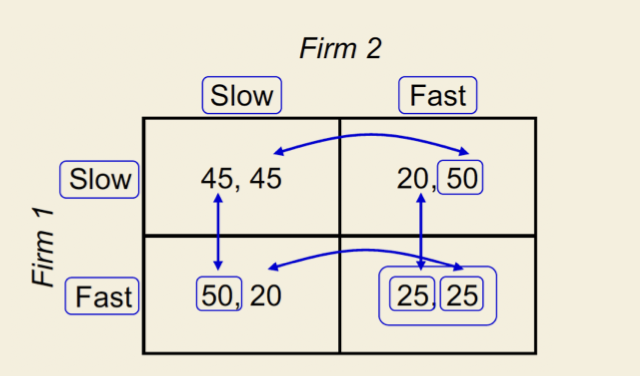
The Nash Equilibrium here would be , of course it is not the efficient case. (Create the incentive to invest too much too early in order to establish (overproduce problem))
Otherwise we use the Tied Ownership method, the Tied Ownership method encourage efficient exploration and extraction.
In this case, no matter of the speed, each firm would get the same outcome (\50$), in this case, in order to avoid earning less, both firms would choose to drill slowly.