Recall some model setting:
- Government Spending:
- Tax Revenue:
- Lump-sum tax (We usually ignore it)
- Labour-income tax
- Capital-income tax (What we are interested in this chapter)
Government Side
We are going to change (holding constant) to see how affects the macroeconomy.
Which means we will assume that Government Spending does not change.
Household Side
Recall, for household, we want to maximize their utility:
the maximization problem is:
s.t.
It is intuitive to use the Hamiltonian to calculate the best answer, lets do this again:
From the equations above, we could get:
Steady State: happens at
When increases, the long-run capital supply curve shifts upward (i.e., reduction in supply).
When the government taxes capital income move heavily, the household accumulates less capital.
Similar, we could get from first two equations:
Graphically Speaking:
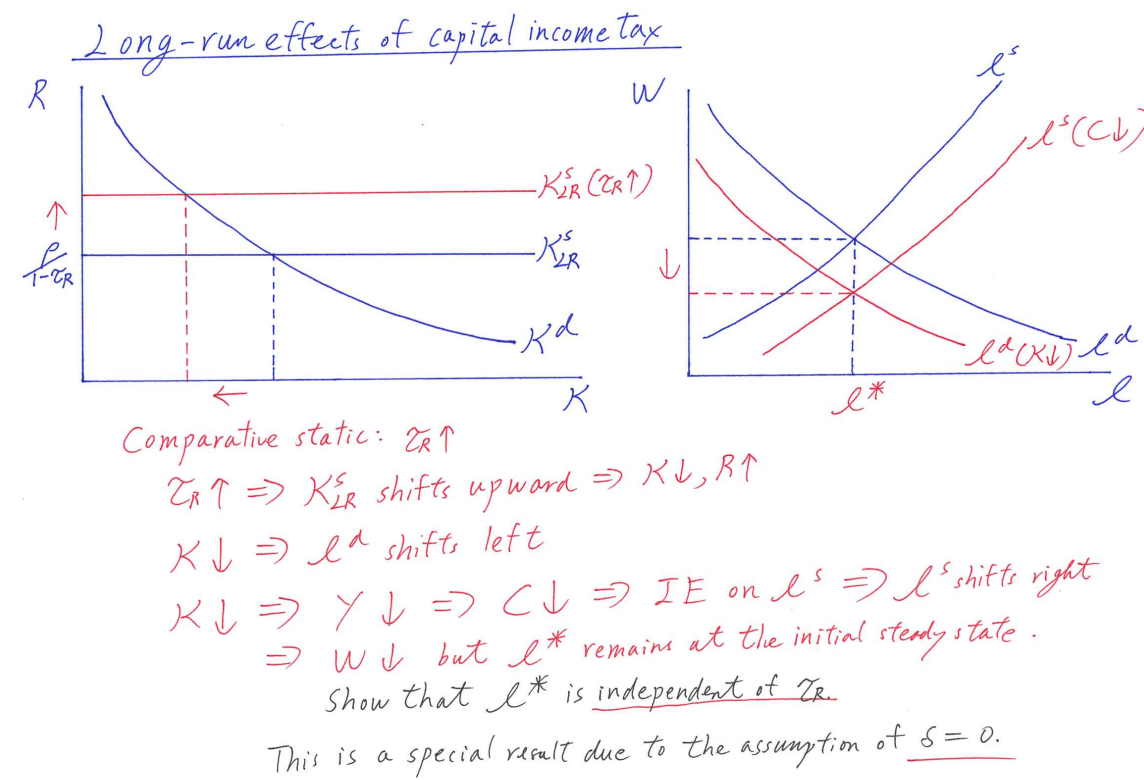
Note that the change in will first affect the Capital Market
To check why the is independent (that is to say, doesn’t change)
Deriving the steady-state level of labor .
Finally, we could get:
Given that ,
is independent of
Deriving the Consumption-output ratio
At steady state:
In the output market:
Exercise
- Derive when , show that depends on if
Answer: recall the definition of is the capital depreciation rate,
Now, the asset-accumulation equation of becomes:
We should then redo the Hamiltonian:
Use the 1, 3 equation:
We could get:
Also recall the equation we use when finding the :
Since it is at the steady state, that is ,
That is to say, we have to derive
At long-run,
So that when , we could get:
That is,
So we plug it in the original equation, the we could get:
Exercise for Capital Income Tax
Capital Taxation in the Neoclassical Growth Model
Household
s.t.
Then we redo the Hamiltonian, but the steps are the as what we see in Exercise for Capital Income Tax